Years ago I hired an offshore team that promised a working app for $15,000 in three months. Eighteen months and roughly $50,000 later, I had nothing I could ship. When I finally got a developer I trusted to open the codebase, there was no real structure to speak of, functions copy-pasted six times with tiny variations, no tests anywhere, and features that looked finished in a demo but broke the moment a real user did something unexpected. That is when I understood we did not have a slow project. We had no project.
Knowing how to choose a mobile app development company is the difference between that eighteen months and an app that actually ships. You have decided to build. Now you are staring at a dozen agencies, all promising the same thing, all sounding confident, all quoting wildly different numbers. If you want a scored shortlist before reading further, our research-backed ranking of the best app development companies in the USA compares 20 firms on a published rubric. The hard part is not finding a developer. The hard part is telling the real one apart from the one who will take your money and your time and leave you with a broken shell.
This is the guide I wish I had before I lost both.
To choose a mobile app development company, vet six things before you sign. Confirm they understand your business, have shipped your features, will run a small paid research phase, will put you in front of the builders, can prove capability with real apps, and set honest expectations. Then check their process for structured research, a thoughtful estimate, and continuous updates
Why do so many app agency engagements go sideways?
Most app engagements fail for a handful of predictable reasons, and almost none of them are visible in the sales call. I learned this as a buyer before I learned it as a builder. I want to be clear about the number, because it is mine and not a market statistic. That failure is why I built my own team, hired full-time engineers from UCLA, and eventually grew apps to more than a million users and more than a million dollars raised. I am telling on my own past so you do not repeat it.
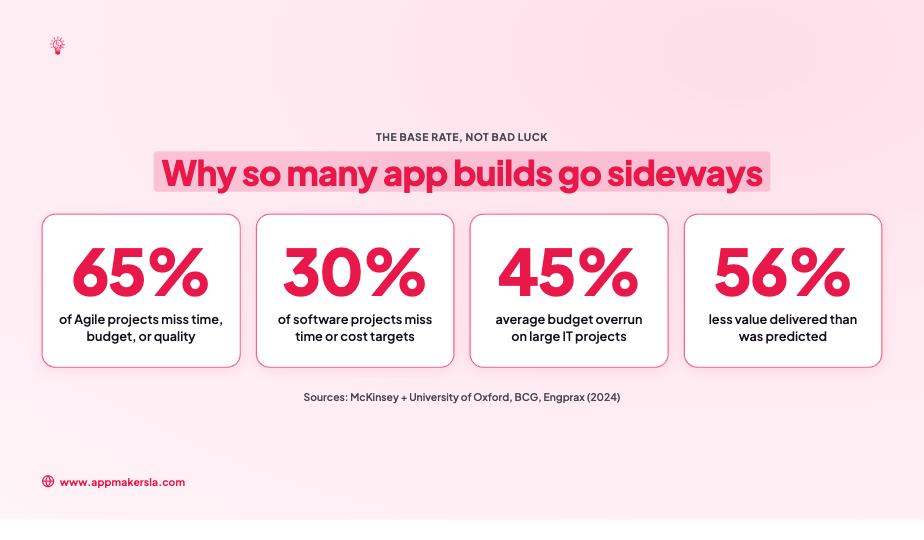
The data backs up how common this is. A 2024 study of 600 software engineers found that 65% of projects using typical Agile requirements practices fail to be delivered on time, on budget, and to a high quality standard, a finding independently reported by The Register.
Boston Consulting Group's 2024 research found that 30% of software development projects miss their time or cost targets, and half of those still fail to meet expectations. The pattern is not new. Over a decade ago, McKinsey and the University of Oxford studied more than 5,400 large IT projects and found they ran 45% over budget while delivering 56% less value than predicted. These are not freak accidents. They are the base rate when nobody vets the process up front.
When the original developer goes dark, the founder is usually the last to know. If that has already happened to you, you are not out of options, and an offshore build can often be recovered without starting over.
The trap almost always looks the same from the inside. You go two more weeks, then two more weeks, then two more weeks. The next thing you know it has been a year and a half. You think you are right at the edge. You are not, because the app is fundamentally broken inside and the engineers were never skilled enough to see it through.
Knowing what to look for is how you avoid being that founder. If you have already been burned, AppMakers USA's Fix Your App service exists for exactly this situation, rebuilding what an offshore team or an AI tool left behind. For everyone earlier in the process, the six criteria below are the filter.
What six things should you look for in an app development partner?
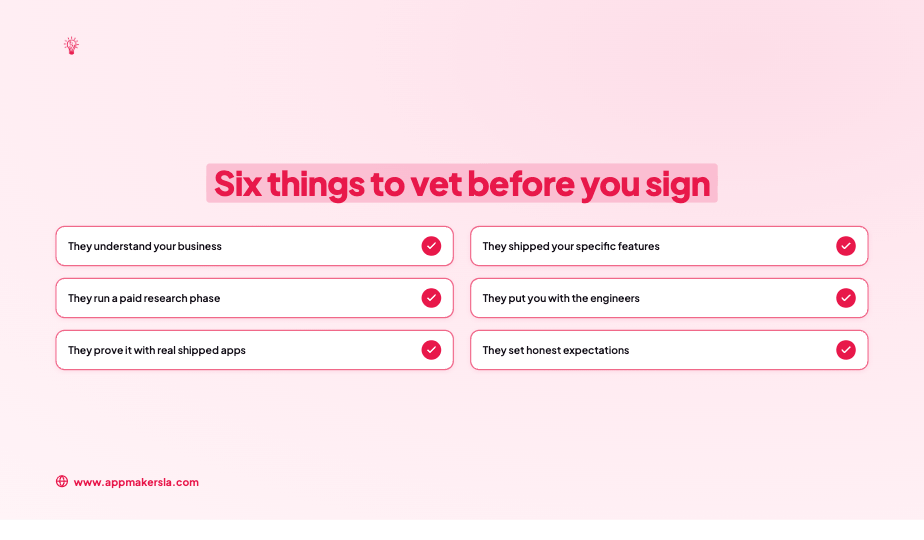
Look for six things before you sign: business understanding, relevant feature experience, a paid research phase, executive-level access, demonstrated capability, and honest expectations. Each one filters out a distinct failure mode. Miss one and you reintroduce the risk it was protecting you from.
1. They understand your business, not just your tech
A good partner asks what your app is supposed to do for your business before they ask what it should look like. Someone will build you an app and you will say ABC and they build exactly ABC the way they see it. Then you realize there were ideas living between the cracks, things you assumed they would assume, and they did not.
The agency that probes your goals first is the one that fills those cracks. AppMakers USA builds at the intersection of business and tech, which is why our mobile app development process starts with what you actually need, not just a feature list.
2. They have shipped your specific features
Generalists who have built "all kinds of apps" are a softer signal than a team that has shipped your exact hard parts. If your app needs payments, refund flows, or real-time sync, ask to see a build that already does that. A team that has shipped subscriptions, financial flows, or offline data handling will price and plan those features realistically. A team that has not will discover the difficulty mid-build, on your dime.
The same logic applies to your tech stack: if you're weighing native builds against a single cross-platform codebase, ask specifically about their track record as a Flutter app development company, since Dart and Flutter expertise isn't automatic even for agencies that ship iOS and Android apps every day
3. They run a small paid research phase before quoting big
The best agencies pump the brakes on closing the deal, even when that means less money up front. They research and design the whole thing first. They map the technical angle and the product minutiae most people miss, the admin panels, the controls, the scaling, the refund flows, all the things that can balloon a project's cost.
Most of these are hidden costs in mobile app development that surface late when nobody mapped them early. That work is what lets a team quote accurately instead of guessing.
4. They put you in executive-level conversations before you sign
If the only people you talk to before signing are salespeople, you do not know who is building your app. Demand a conversation with the people who will actually write the code or run the project. A salesperson's job is to close. An engineer's job is to tell you the truth about what your idea will take. You want the truth before the contract, not after.
5. They can prove capability with real shipped work
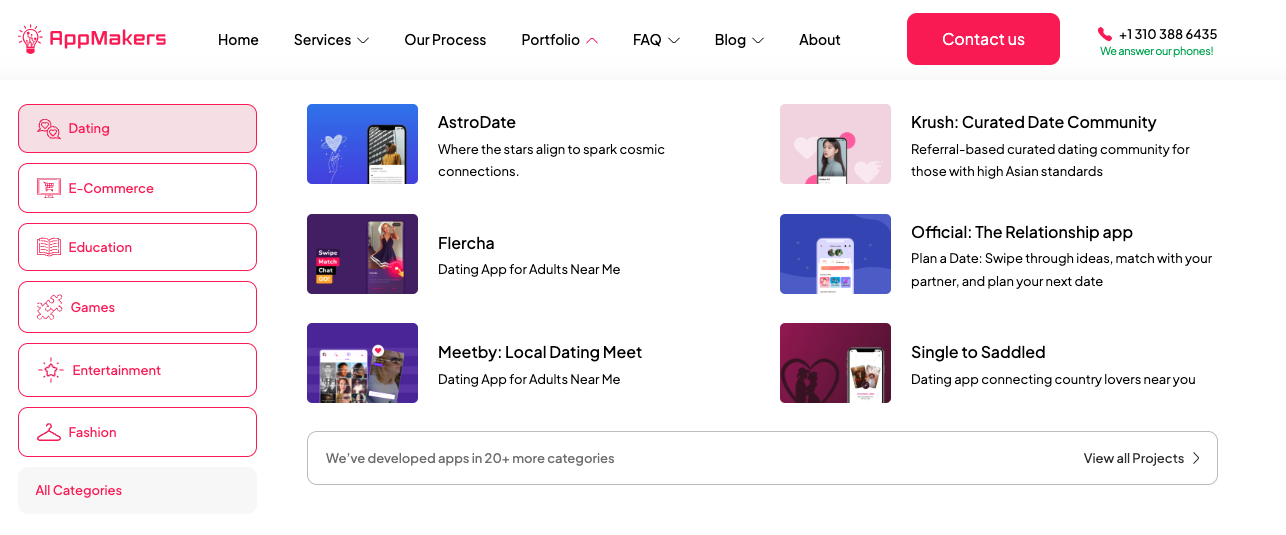
Ask for live apps in the stores, not slide decks. Real demos, real case studies, real downloads. A team that hands your project off to a faceless subcontractor cannot show you a portfolio that is genuinely theirs. AppMakers USA makes every hire individually, as full-time employees we have worked with for a long time, which is what lets us stand behind the work in our portfolio.
6. They set honest expectations
Premium does not mean the code is merely better. It means the product is polished, feels like an app people want to use, and gets delivered when and how the team said it would. An honest partner will tell you what will not fit in your budget instead of promising everything and delivering a broken version of it. That honesty is uncomfortable in a sales call. It is the single best predictor of a finished app.
Those six criteria tell you who the partner is. The next question is how they actually work.
What does a healthy agency process actually include?
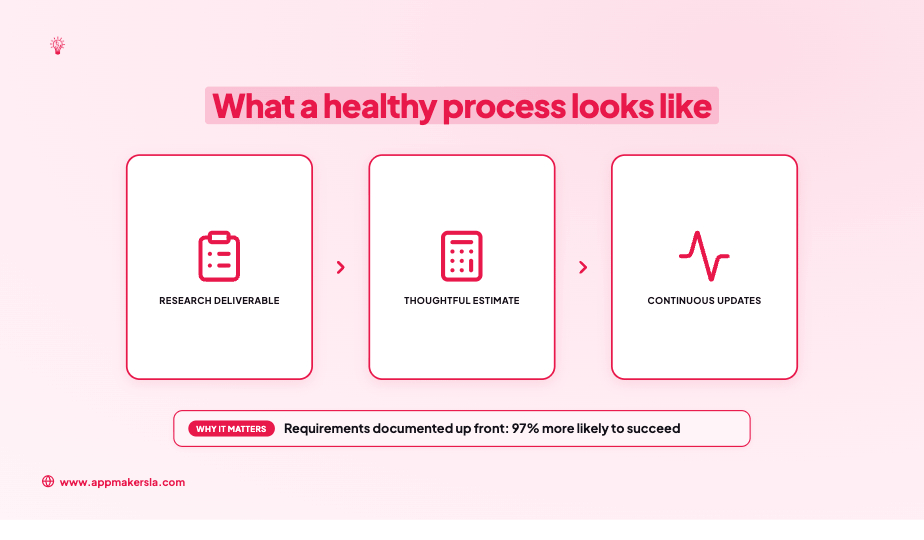
A healthy agency process has three parts: a structured research phase with a real deliverable, a thoughtful estimate built on engineering work, and continuous progress updates you can see. These three are what turn a hopeful quote into a predictable build.
If you want to see how the stages fit together, this breakdown of how the mobile app development process works maps the full path from research to launch. The research firms agree on why this matters. The Engprax study found that projects with clear requirements documented before development began were 97% more likely to succeed.
Clear requirements are not bureaucracy. They are the cheapest insurance you will ever buy.
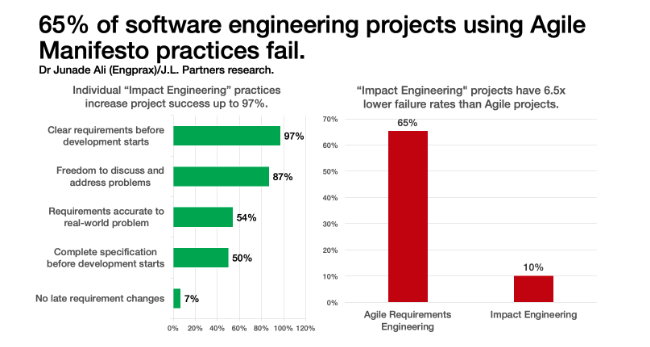
Source: Engprax
A real research deliverable, not a verbal promise
A good research phase produces something you can hold: wireframes, a technical roadmap, or a research document. It is where the team finds the cost-ballooning details before they balloon. If an agency wants to skip straight to coding without mapping the product first, that is the warning sign.
The structured discovery you would want here is the same backbone of AppMakers USA's custom software development work, where the research phase exists to surface risk before a line of production code is written.
A thoughtful estimate, not a finger in the wind
Estimating is as much an art as a science. About a decade ago I asked one of my engineers for a perfect estimate on an internal project. He said, "If you want a spot-on estimate, I can build the whole thing and then tell you how long it took, and that will be the estimate." He was right. The teams that get closest to the nail are the ones that have built hundreds of projects.
Because our research process captures the minutiae that wreck timelines, our estimates usually land within about 5% accuracy. That is my number, from our work, not a market figure.
Continuous progress you can actually see
You should see design updates weekly and development updates on a regular cadence. Silence is the enemy. The offshore team that burned me went quiet for stretches, and every silence was hiding a problem. A partner who shows you progress on a schedule cannot let a project drift unnoticed for a year and a half.
A clean process is necessary but not sufficient. You still have to ask the right questions, out loud, before you sign.
What questions should you ask before hiring an app developer?
Ask questions that force the agency to reveal who builds your app, how they estimate, and what happens when scope changes. The goal is to move past the rehearsed sales pitch and reach the people and the process underneath it. Here is a list you can copy directly into your next call.
- Who actually writes the code, and are they full-time employees of your company?
- Will you subcontract any part of this, and if so, to whom and why?
- Can I talk to an engineer or project manager before I sign, not just a salesperson?
- Show me a live app you shipped with my hardest feature (payments, real-time sync, offline mode).
- Show me a project where the scope changed mid-build. What did you do?
- What does your research or discovery phase produce, and is it paid?
- How do you build your estimates, and how accurate do they usually turn out to be?
- Who owns the code and the intellectual property, and when do I get access to the repository?
The single most revealing question is number two. A partner who answers "we close the deal and hand it off to our company in Ukraine or India" has just told you they are shedding responsibility and not owning the hire. That is different from a great engineer abroad working as part of one accountable team, which is fine.
The difference is who owns the hiring decision. AppMakers USA answers these questions the same way every time, which is part of why founders come back to us for hiring app developers on later projects. The way an agency answers these eight questions is also the fastest way to spot the red flags below.
AppMakers USA puts you in front of the engineers before you sign, not after. You will talk to the people who will build your app, see a research deliverable before you commit, and get an estimate built on real engineering work. No salesperson firewall, no offshore handoff.
Talk to Our Team Today →
What are the red flags, and what should you demand in writing?
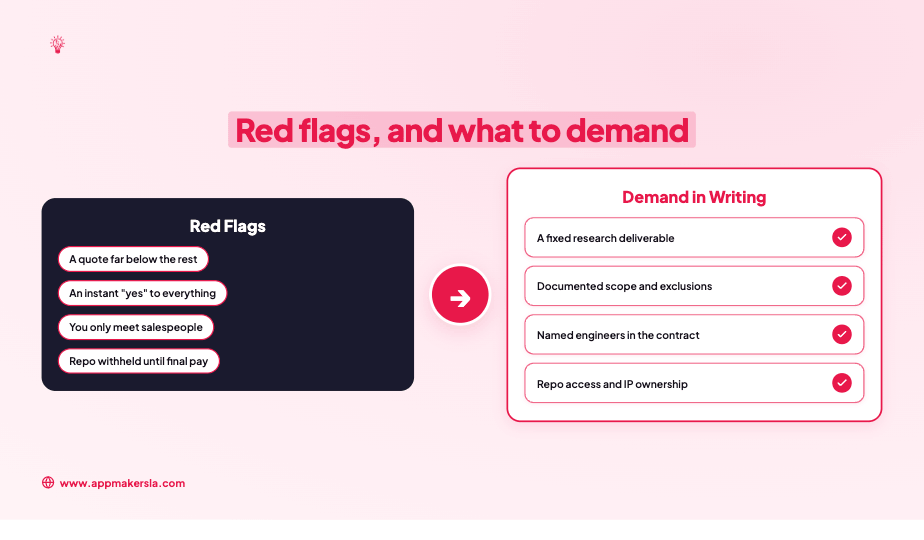
The dangerous red flags are the ones that sound reassuring in a sales call. A low quote feels like a win. An instant "yes, we can do that" feels like confidence. Both are usually the opposite. The table below translates the signal into what it means and what to lock into the contract.
| What it looks like | What it actually means | What to demand in writing |
|---|
| A quote far below the others | They have not researched the hard parts and will bill you for them later | A fixed research deliverable, plus how change requests are priced |
| An instant "yes" to every feature | They have not thought about scaling, refunds, or edge cases | A documented scope with named features and explicit exclusions |
| You only meet salespeople | The builders are hidden, possibly subcontracted | Named engineers or PMs assigned to your project before signing |
| "We hand it off to our partner team" | They are not owning the hire or the accountability | Direct access to whoever writes the code, named in the contract |
| Vague payment terms | Misaligned incentives, hard to walk away cleanly | A milestone-based payment schedule tied to deliverables |
| Repo withheld until final payment | You have no control and no proof of progress | Repository access and IP ownership terms stated up front |
The contract is where good intentions become enforceable. Demand a documented scope, a milestone-based payment schedule, named builders, and clear IP ownership before you sign anything. If an agency resists putting any of these in writing, that resistance is your answer.
The same diagnostic eye is what AppMakers USA's Fix Your App audit applies to inherited codebases, the broken builds founders bring us after they ignored these flags the first time. If you are choosing a rescue team specifically, the criteria shift slightly, and this guide on what to look for when hiring an app rescue service covers the difference.
If your app is already broken, AppMakers USA can tell you exactly what went wrong. Our Fix Your App audit reviews the codebase, finds the failure points, and gives you a clear assessment before you commit to a rebuild.
Book a Free App Audit →
When should you NOT hire a US agency at all?
You should not hire a US agency if your total budget is under roughly $15,000. That is my honest threshold, and most agencies will not say it out loud. Below that number, you generally do not have enough to get serious software off the ground, and a good agency will not start what it cannot finish. The last thing any responsible team wants is to begin your project and then run out of runway halfway through.
If you are under that floor, you have better options than overpaying for a partial build. Use a no-code tool to test the idea, or hire a single vetted onshore developer for a tightly scoped version. Spend the money proving the concept first, then come back when you are funded enough to see a real build through.
As a salesperson, it is always harder to put the hard truth on the table. We find it rewarding anyway, because it means we only start projects we can carry to completion. That is the honest version of premium. If you are funded and ready to build the real thing, AppMakers USA's mobile app development team will tell you the truth about scope before you sign. If you are not there yet, the most useful thing we can do is tell you that too.