New ways to charge for AI-powered features are showing up because the old math broke.
A flat subscription can’t absorb variable inference costs, and “we’ll eat it” stops working the first time usage spikes or your model changes. Customers, on the other hand, don’t want surprise bills or pricing that feels like a black box.
So the job is twofold: protect margins while making the value feel fair.
Below, we’ll walk through how teams are pairing predictable plans with usage, how they’re packaging AI without nickel-and-diming, and how to meter the right things so finance and product aren’t at war. If you’re shipping AI into a real SaaS product, this is how you charge with confidence without pricing yourself into chaos.

If you want new ways to charge for AI-powered features to actually stick, start with the boring part: goals and cost floors. Otherwise, you end up “pricing vibes” and praying usage stays low.
First, decide what this feature is supposed to do for the business.
Is it a loss leader to drive adoption? A core value driver that keeps customers around? An upsell lever? Or the thing that’s supposed to expand margin?
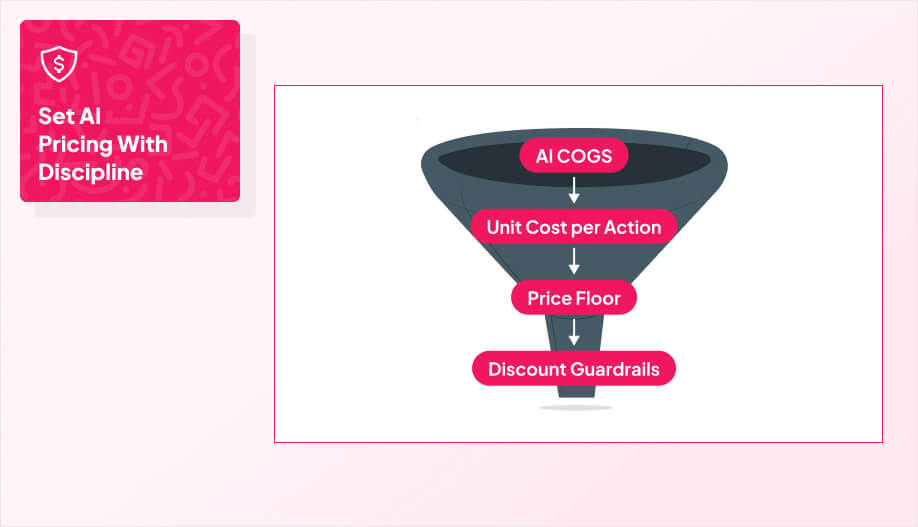
That answer changes everything about packaging, discounts, and what you’re willing to include for “free.” Then set a clear price floor from fully-loaded unit COGS (Cost of Goods Sold), whether that unit is per seat, per request, or per feature action. Remember that COGS is recorded as a debit on the income statement and is essential for determining gross profit. Lock discount guardrails early so a few deals don’t quietly destroy the model.
Next, get specific about what “AI COGS” actually includes. It’s not just tokens. It’s inference plus the infrastructure around it and that includes vector databases, monitoring, and the support work that comes with running AI in production.
Keep overhead and admin out of this number. You want direct, defensible costs tied to delivering the service. Convert that into unit COGS per event, run scenarios (normal usage vs. power users vs. worst-case spikes), and make sure you have efficiency levers planned before you need them.
One practical move that helps teams is to treat cost modeling and metering as part of the build, not a finance cleanup project later. That is where a product engineering team can take a lot of risk off the table, by designing the feature, the meter, and the guardrails together so pricing stays stable even as models and usage evolve.

Pricing clarity starts with meters, because AI isn’t a flat-cost feature.
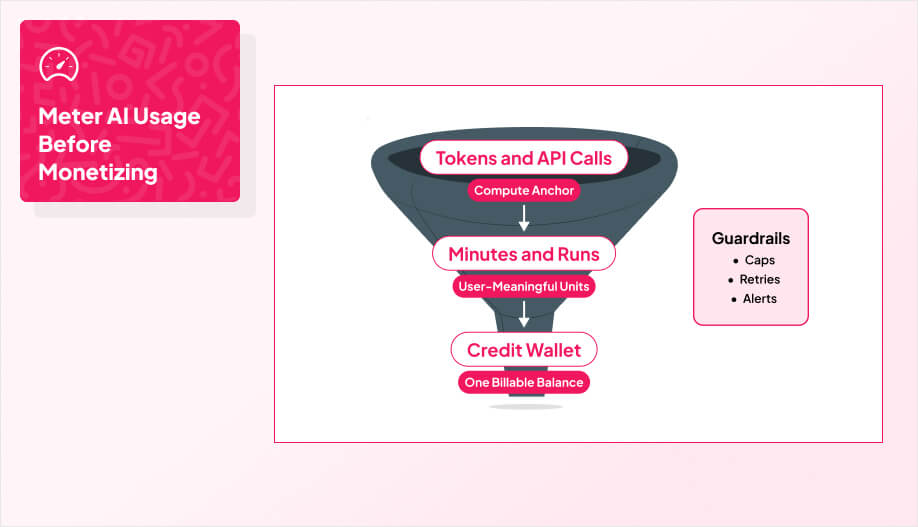
If usage doubles, your bill can double right along with it, especially when you’re paying per 1K tokens and premium models can cost materially more than lighter tiers. That’s why the first step is usually anchoring costs to what you can measure cleanly and that is tokens and API calls.
Treat tokens as the base compute proxy, separate input vs output costs, and calculate a unit cost per action using a simple model: average tokens per action × your per-1,000-token rate × a safety margin, then layer in overhead.
The hidden killer is the context window tax. Long prompts inflate token spend even when the output is short, so caps, compression, and retry limits are not “optimization,” they’re margin protection. Dashboards and alerts matter here too, because customers tolerate usage pricing a lot more when they can see it before it hurts.
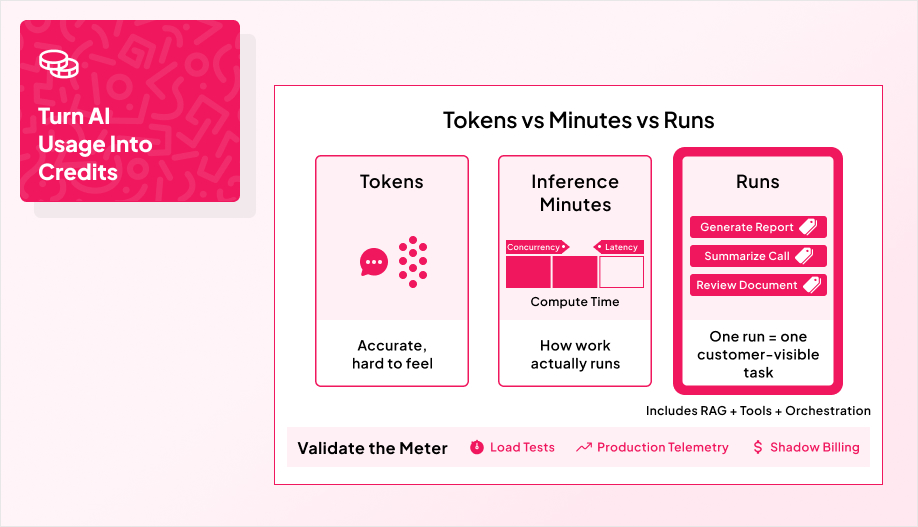
Tokens are accurate, but they’re not always intuitive. That’s where inference minutes and runs come in.
Minutes map pricing to how work actually runs, including concurrency and latency, not just text length. You aggregate compute time into minutes and normalize it so different hardware or deployments still translate into a consistent meter. Buyers also understand minutes more easily than tokens, especially when they’re comparing plans month to month.
Runs help when the user experiences a discrete task, like “generate a report,” “summarize a call,” or “review a document.” You wrap the internal complexity, RAG, tool calls, and orchestration into one run so the customer pays for the action they recognize, while you enforce guardrails so the average run stays inside your cost targets.
This is also where load tests, production telemetry, and shadow billing stop being nice-to-haves. They’re how you find out whether your meter matches reality before the bill does. In real launches, this is the part that gets tuned over time, not guessed once.
For product teams shipping AI into mobile apps, especially in cross-platform app development, these meters align neatly with how users experience features on both iOS and Android.
Now, credits exist because most teams eventually want one number customers can live with. A margin-aligned credit model takes tokens, minutes, and runs and converts them into a single balance that represents a normalized unit of work and cost.
The goal is predictable economics, this means peg each credit to fully loaded marginal cost, price it between 70% to 85% to preserve healthy gross margins, and create classes so heavy tasks don’t quietly cannibalize the rest of the product.
A burn table makes the system legible, both internally and for customers. You decompose what a “unit of work” really costs, publish what common actions consume, and use credits to flag when high-cost usage patterns require an upgrade instead of letting them silently erode margins. Some teams also add limits, caps, and scheduling rules inside the credit logic to control spend and reduce waste.
The bigger point is consistency: you can change models under the hood, but the customer sees a stable pricing contract.

Now that you can meter usage, you can price it like an adult.
The job here is simple: map pricing to value while protecting margin. AI-first products carry variable costs that scale with usage, so if your pricing ignores that, you’ll feel it the moment a few power users show up. At the same time, if your pricing feels unpredictable or confusing, customers won’t trust it, even if it’s technically “fair.”
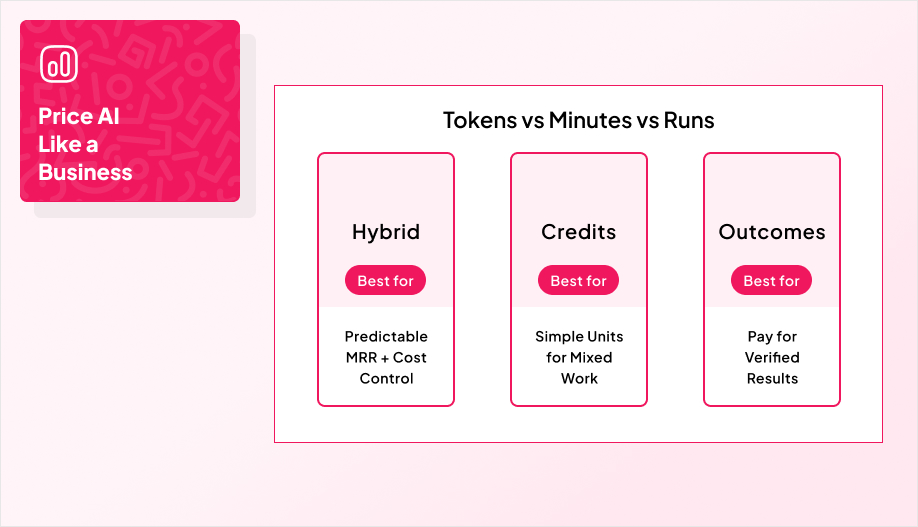
Most teams land on one of three models, depending on how predictable the usage is and how measurable the value is:
The trap is pretending there’s a perfect model on day one. In fact, 95% of AI startups misprice their offerings and iterate pricing to align with value. AI pricing usually needs a pilot period because it’s easy to misjudge what customers will actually use and what it costs you to deliver.
Next, we’ll break down each model, what it’s best at, and where it tends to break.

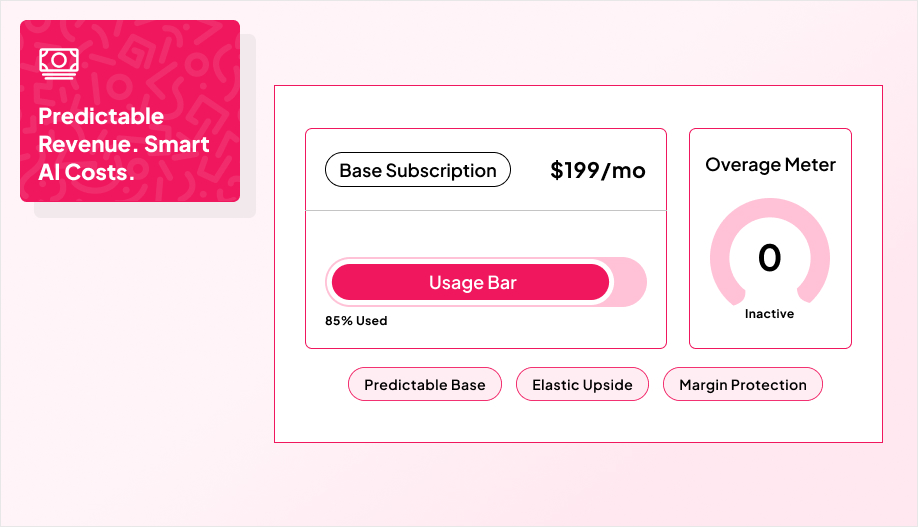
Hybrid pricing works because it matches how AI behaves in the real world.
Your costs track tokens, API calls, and compute time. A flat subscription looks “simple” until a handful of power users quietly turn your margin into a donation. Pure usage pricing has the opposite problem and that is it being fair on paper, but it makes budgets feel slippery, which slows adoption and creates churn the moment customers get surprised.
A hybrid plan gives you both levers. You charge a recurring base so customers can forecast and procurement can approve, then you meter the heavy lift so cost-to-serve stays aligned with revenue.
At the same time, subscription-only models are projected to decline by 5% over the next year. That’s also why a lot of teams are tightening free usage, adding rate limits, and moving advanced AI capabilities into paid tiers. Hybrid models have been gaining share in SaaS as companies blend predictable subscriptions with usage elements that scale with consumption.
Here are the three hybrid structures that show up the most:
| Hybrid Structure | How It Works | Best Fit |
|---|---|---|
| Base + Included Allowance | Fixed monthly fee with a generous included pool; overage keeps things flowing without hard stops. | Mid-market SaaS where customers want predictability but usage varies. |
| Commitment + Usage | A committed spend covers baseline costs, then usage kicks in for spikes. | Enterprise contracts, where you need cost coverage and elasticity. |
| Per-Seat + Pooled Allowance | Seats scale the plan, but usage draws down from a shared pool, with soft caps to prevent runaway spend. | Teams adopting AI across departments without wanting per-user chaos. |
Two practical notes that keep hybrid from backfiring:
If you want to pressure-test the tiers and meters before you ship them, that’s the kind of product + billing work our team at AppMakers USA can help with, especially when AI features sit inside a larger roadmap and you need pricing that won’t collapse under real usage.

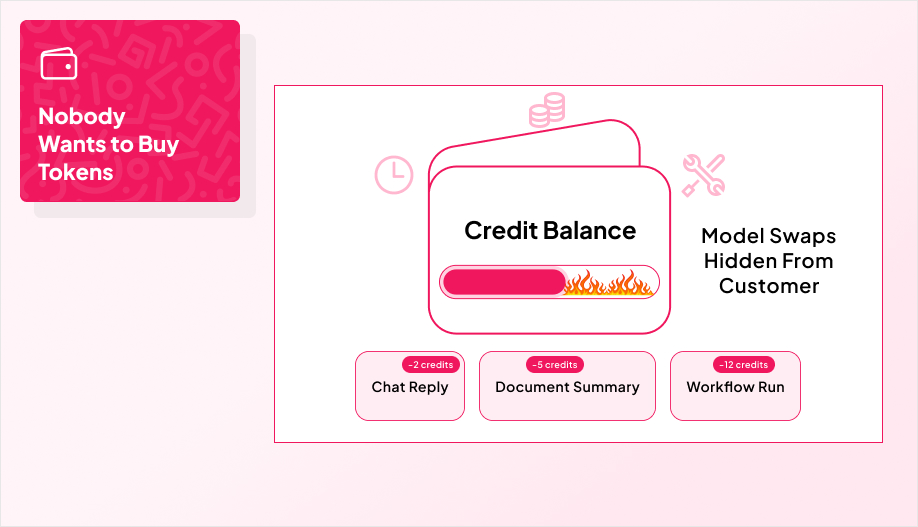
Credits exist because nobody wants to buy tokens.
Most customers do not care about GPU minutes, model swaps, or whether a workflow used chat, embeddings, and file analysis under the hood. They care about two things: “How much is this going to cost me?” and “What do I get for it?”
A prepaid wallet with credits answers both. You sell an abstract unit, fund the wallet up front, and burn credits per action instead of per token. That keeps the pricing anchored to the work the customer recognizes, while giving you room to change models, routing, or infrastructure without rewriting your entire price page.
This is why credit wallets keep showing up in AI products. They simplify the buying experience and make budgets feel stable even when underlying costs bounce around.
On your side, you get earlier cash, cleaner forecasts, and fewer billing disputes because usage is capped by the wallet balance. On the customer side, they get hard spend limits, visibility into remaining balance, and safe room to experiment without getting ambushed by an invoice.
The key is to design credits like a product, not a billing hack.
Define the credit using both a cost model and a value model. Set clear burn rules per action, bundle packs so common workflows can be completed multiple times, and publish the policies that prevent fights later: expiration, refunds, and overage behavior. Then add the basics that make it feel trustworthy in day-to-day use: auto top-ups, low-balance alerts, and real-time dashboards.
This structure is especially clean for agent-based features where a single “task” might involve multiple tool calls and orchestration steps, but the customer still expects one simple unit to pay for.
This is the kind of packaging + metering work AppMakers USA builds alongside the feature itself so pricing does not break once usage gets real.

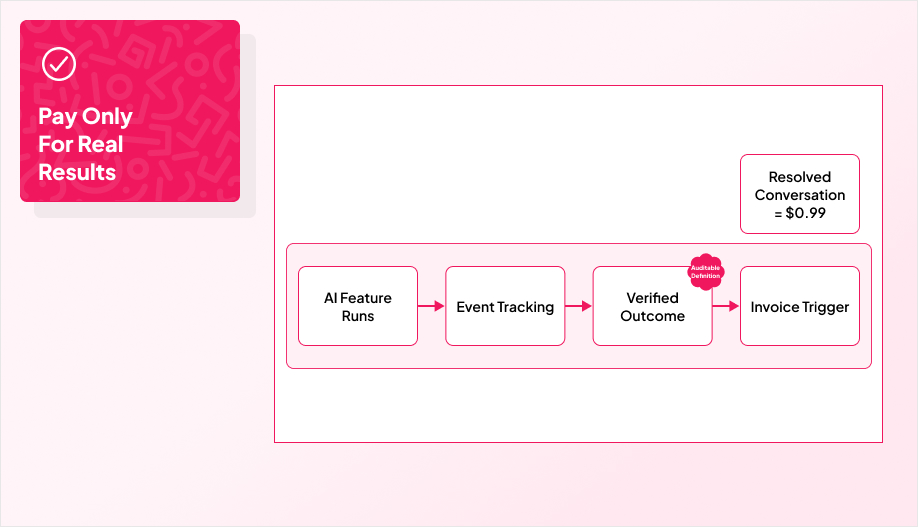
Outcome-based pricing is the cleanest story you can tell a customer: you pay when the result happens, not when the model ran.
Done right, it turns pricing into ROI instead of access, which usually shortens the “is this worth it?” debate and build trust because customers are not paying for effort, they’re paying for an outcome they can see.
A strong real-world example is Intercom’s Fin, which charges $0.99 per resolution. That works because the unit is obvious and the result is measurable.
The hard part is not the price. It’s the proof.
Outcome pricing only holds up if you define the outcome clearly, instrument events end to end, and set attribution rules that survive edge cases and audits. When multiple systems contribute, you need a source of truth, a threshold that counts as “success,” and written rules for disputes, SLAs, and escalation paths. Billing tooling can help operationalize it, but it does not replace the measurement discipline.
Platforms like Lago are built around event-driven usage metering and invoicing, which is the kind of foundation you need when billing is tied to verified events.
If you want this model to work in a real product, the work usually lives in the plumbing data pipelines, event tracking, and contracts that make “what counts” unambiguous. That’s exactly where our team at AppMakers USA tends to step in, because outcome pricing falls apart fast when the instrumentation is fuzzy.

Clarity sells AI.
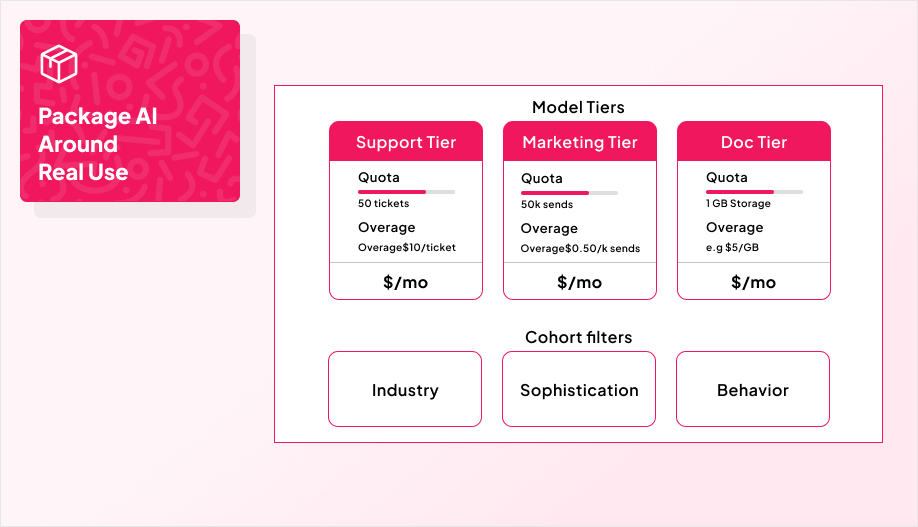
“Unlimited AI” sounds nice until finance gets the bill and support gets the angry emails. So instead of bundling a grab bag of features, package AI pricing around use cases people already understand.
A Support tier can price around resolved conversations. A Marketing tier can price around generated campaigns. A Docs tier can price around analyzed files.
Each tier includes a baseline of core AI, then unlocks better models, templates, and automations as price rises. The important part is the guardrails: attach explicit quotas and a clear overage path so unit economics stay intact. A two-part structure works well here too: a predictable base so customers can budget, plus usage that scales with consumption when they go heavy.
And when a use case has a clean “win” you can measure, you can layer an outcome-based add-on on top, but only if success metrics and tracking are airtight.

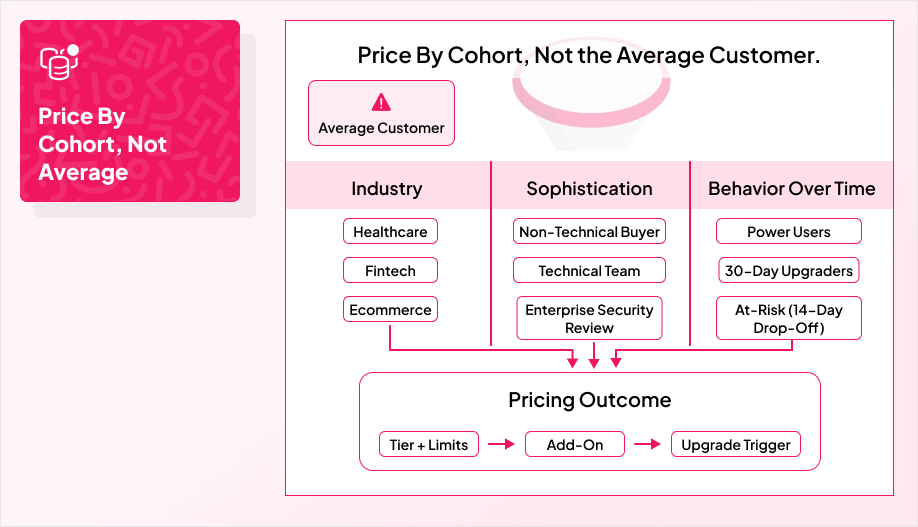
Once the tiers make sense, you make them pay by segmenting by cohort instead of pricing to an imaginary “average customer.” Companies that adopt cohort analysis are 37% more likely to scale AI deployments.
Three cohort lenses are usually enough to start: industry, technical sophistication, and behavior over time.
Industry changes willingness to pay and what “value” even means. Sophistication changes how much transparency and control buyers expect. Behavior is where the money is. Track adoption by signup cohort, then build plays for power users, steady upgraders, and at-risk accounts.
For example, target customers who buy repeatedly in a short window with premium capabilities, nurture the ones who tend to upgrade around the 30-day mark, and re-engage users who go inactive after two weeks before they disappear for good.
This is the part teams skip, then wonder why pricing turns into support tickets and margin surprises.
If you’re going to charge for AI usage in any form (tokens, minutes, runs, credits, outcomes), you need four pieces of plumbing that make the billing contract real.
| Implementation Piece | What It Prevents | What To Build |
|---|---|---|
| Usage Ledger | “We can’t explain this invoice” disputes | An append-only event ledger that records every billable action with: customer, feature, meter/credit burn, timestamp, and a correlation ID back to the request. This becomes your source of truth for support and finance. |
| Pre-Authorization (Usage Reservations) | Negative balances and runaway spend mid-workflow | Before running a high-cost action, reserve the estimated cost (or credits). If the wallet can’t cover it, block, downgrade, or require an upgrade. Release unused portions after completion so customers don’t feel nickeled. |
| Dashboards + Alerts | Surprise bills and churn from “black box” pricing | A customer-facing usage dashboard that updates in near real time, plus alerts at sensible thresholds (50%, 80%, 100%). Add low-balance warnings for wallets and clear “what happens next” messaging when they hit limits. |
| Caps + Guardrails | One power user nuking unit economics | Hard caps for prepaid plans, soft caps with overage for hybrid, rate limits for abusive patterns, retry limits to stop token burn loops, and per-tenant ceilings so one account can’t spike your infrastructure bill. |
If you build these four, you get something rare in AI pricing: predictability on both sides. Customers understand what they’re paying for, and you can enforce costs before they turn into a margin leak.
Start with the unit the customer actually feels. If they experience “generate a report” or “resolve a ticket,” meter that run or action first, then back into tokens/minutes internally. You can always get more granular later, but you can’t recover from a pricing model customers don’t understand.
This is exactly why credits and action-based meters exist. Keep the customer contract stable (credits per action or price per outcome), then adjust your internal burn rates and routing as costs shift. Customers hate volatility. Your finance team hates surprises. Stable externally, adjustable internally is the clean compromise.
When “success” is messy. If multiple systems influence the outcome, attribution becomes an argument instead of a metric. Outcome pricing works when the event is unambiguous, auditable, and you can define edge cases up front without writing a novel.
Yes, when the AI is table stakes for the product experience or it drives adoption of your core paid workflow. But you still need guardrails. Included doesn’t mean unlimited. It means “included up to a sane boundary.”
Pilot it with a small cohort and run shadow billing first. Show customers what they would have paid before you actually charge them. Then tighten the meter, adjust thresholds, and only flip on billing once the invoices match what customers expect.
The new ways to charge for AI-powered features are really about control. Not control over customers, control over your own unit economics as models, usage patterns, and customer expectations keep shifting.
The teams that win here treat pricing as part of the product surface. They pick a billing unit customers can explain to a teammate, they instrument it so disputes are rare, and they build guardrails that prevent both bill shock and margin leaks. Then they iterate in small, measurable steps instead of betting the company on one perfect pricing page.
If you want to ship this without breaking trust, AppMakers USA can help you design the meter, build the usage ledger and dashboards, and wire the billing logic into the product so pricing stays stable even when the AI underneath changes.