Keeping AI agents secure in real world environments starts with acknowledging they don’t just answer questions.
They read files, call APIs, and take actions, which means a prompt can become a permission. The risk is a one compromised step that triggers a chain of tool calls, data exposure, or silent changes inside your systems.
This guide focuses on controls that hold up after launch and this includes least-privilege identities for agents, strict tool gating, memory and retrieval hygiene, runtime isolation, and audit trails you can actually investigate. If you’re deploying agents inside a real product, treat security as architecture, not a checkbox.
Plan for failure: runtime isolation, audit-grade logs, monitoring, and kill switches so you can contain damage fast and investigate what actually happened.
AI agents don’t behave like traditional machine identities because they aren’t executing a fixed script.
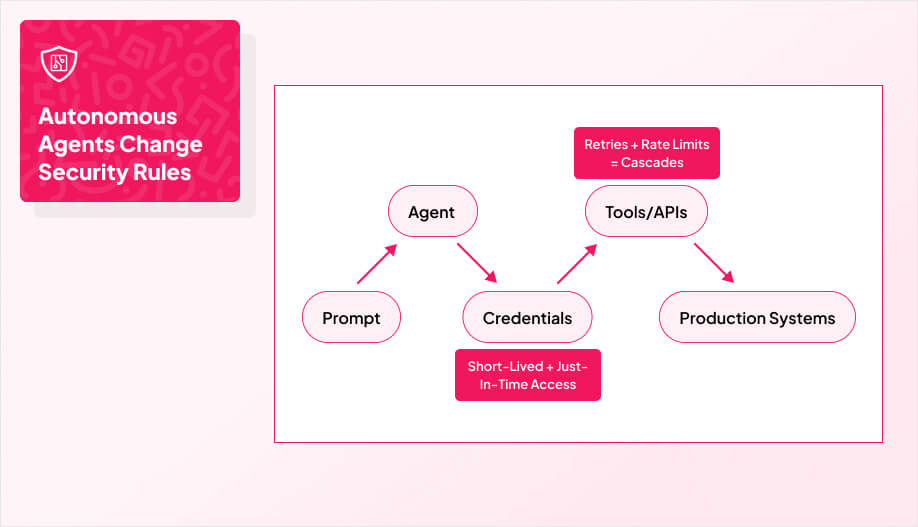
They interpret context, decide what to do next, and then chain together API calls and follow-up requests to reach a goal. That autonomy changes the security baseline and this means that the “prompt” isn’t just input, it can steer behavior and trigger actions.
This challenge is compounded by the fact that agents can now make over one million decisions per hour, vastly increasing operational complexity.
Identity also gets messier fast. Agent instances spin up and down quickly, which pushes you toward short-lived credentials and just-in-time access instead of long-lived service accounts. Meanwhile, most orgs are already drowning in machine identities.
CyberArk reports 80 machine identities for every human identity, and notes that a meaningful share of machine identities carry privileged or sensitive access. Agents add more churn, more entitlements, and more places for permissions to quietly drift.
Once you grant autonomy, the risk jumps again because decisions turn into executed tool calls. And they can fail as they lack the behavioral baselines required to detect machine-speed anomalies.
A passive model can be wrong and you move on. An agent can be wrong and still create tickets, change records, send messages, update infrastructure, or pull sensitive data. That’s where prompt injection, tool misuse, and memory poisoning stop being “AI issues” and become real production security issues.
The governance gap doesn’t help: Okta reports only 44% of organizations have policies governing AI agents, with reports of agents being tricked into revealing credentials and taking unintended actions.
Finally, agent systems amplify failures because they operate inside connected ecosystems. When one tool call fails, the system often retries, hits rate limits, cascades into queue backlogs, and starts failing across dependencies that look unrelated on paper.
Shared components (auth services, rate limiters, vector stores) become choke points, and automated recovery behaviors can accidentally make the blast radius bigger if the system doesn’t have backpressure and hard stop rules.
This is why redundancy in pathways, termination rules, and containment are security controls, not just reliability best practices.
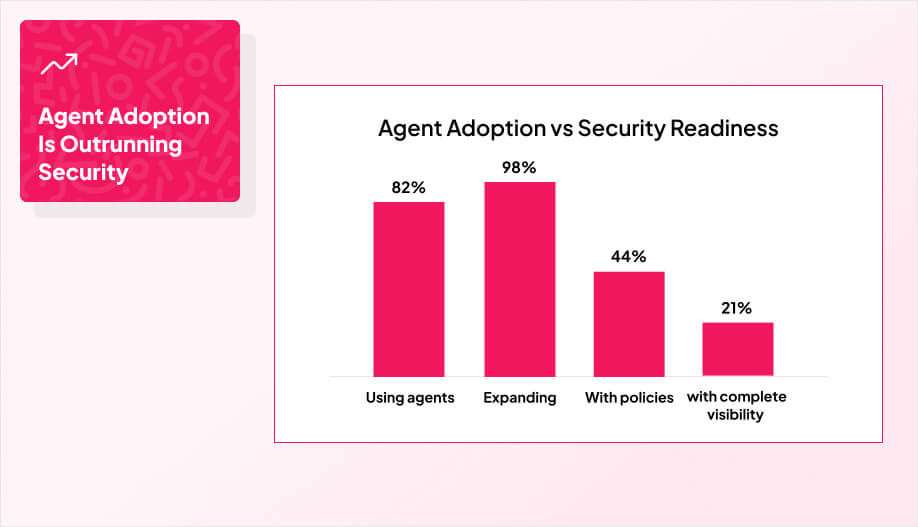
Agent adoption is moving faster than the security muscle needed to run them safely. In one 2025 survey of enterprise IT leaders, 96% said they plan to expand AI agents in the next 12 months. Another security-focused study found 82% of organizations already use AI agents.
The problem is that governance is not keeping pace.
That same SailPoint study reported only 44% of organizations have policies in place to secure agents. And visibility is even shakier where one report found only 21% of leaders claim complete visibility into agent behaviors, permissions, tool usage, and data access. So a lot of teams are effectively shipping autonomous software into production without a reliable inventory of what exists, what it can touch, or how it’s actually behaving.
That gap is not theoretical. Tenable reports 34% of AI adopters have already experienced an AI-related breach, driven largely by familiar issues like vulnerabilities, misconfigurations, and identity sprawl. Looking forward, Gartner predicts that by 2028, 25% of enterprise breaches will be traced back to AI agent abuse.
If you’re scaling agents, the order of operations matter. This means you need to get visibility and ownership first, then tighten access and logging, then let autonomy grow inside guardrails instead of outside them.
When adoption runs ahead of visibility and policy, attackers do not need novel exploits. They just need one weak link in the agent’s inputs, tools, or memory.
In production, agent compromises usually follow a small number of repeatable paths because agents blur the line between “content” and “instructions,” then turn decisions into tool calls. A good example is the Reprompt attack disclosed by Varonis Threat Labs in January 2026, where a crafted link could trigger Copilot into leaking sensitive data through an indirect prompt-injection style flow.
Microsoft patched the issue, but it’s a clean illustration of the core risk where once an assistant can interpret external content and act on it, prompt injection stops being a prompt problem and becomes an access problem.
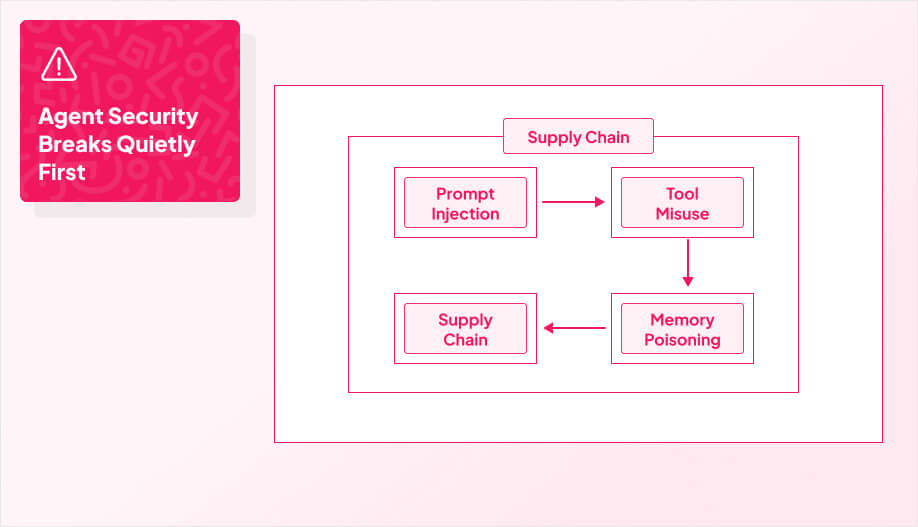
From there, the threat model usually collapses into four buckets you can actually design for: prompt injection, tool misuse/privilege escalation, memory poisoning, and supply chain risk.
Agents process “instructions” and “data” as one stream of text, which creates a built-in weakness: an attacker can slip control signals into the same channel the agent trusts for context.
That semantic gap is the reason prompt injection is more than a content problem. Once an agent is tool-connected, injected instructions can push it past internal guardrails and into unauthorized state changes.
The risk includes direct injection (overt chat commands that override intent) and indirect injection (poisoned external content the agent retrieves and treats as legitimate context). The text obfuscation (for example, invisible characters) bypass detection and get malicious directives executed anyway.
What makes this dangerous in agent systems is that a successful injection does not have to “hack” anything. It just has to win the next-step decision.
Without rigorous validation, the agent cannot reliably distinguish malicious instructions from legitimate requests, so you end up with policy violations, logic subversion, and state changes you did not intend.
This is the classic pivot: once an attacker gets the agent to follow the wrong instruction, they use the agent’s legitimate permissions against you. That’s why the draft calls it “semantic privilege escalation.”
You are not bypassing auth; you are tricking the system into making authorized calls for the wrong reason. Research indicates that attacks utilizing natural language for exploits have been shown to achieve over 90% reliability.
It gets worse because the activity looks normal to traditional controls. This logic gap confirms that existing security frameworks inadequately address new challenges introduced by autonomous decision chains. It also lists concrete examples of what this looks like in practice and it includes pulling sensitive tokens through cloud metadata endpoints, exfiltrating credentials from mounted volumes, and triggering “zero-click” style tool activations via incoming email streams.
The practical takeaway from this is that if the agent has write access to production systems or can trigger privileged endpoints, you are implicitly trusting every untrusted document, email, or retrieved snippet it processes, unless tool use is tightly constrained.
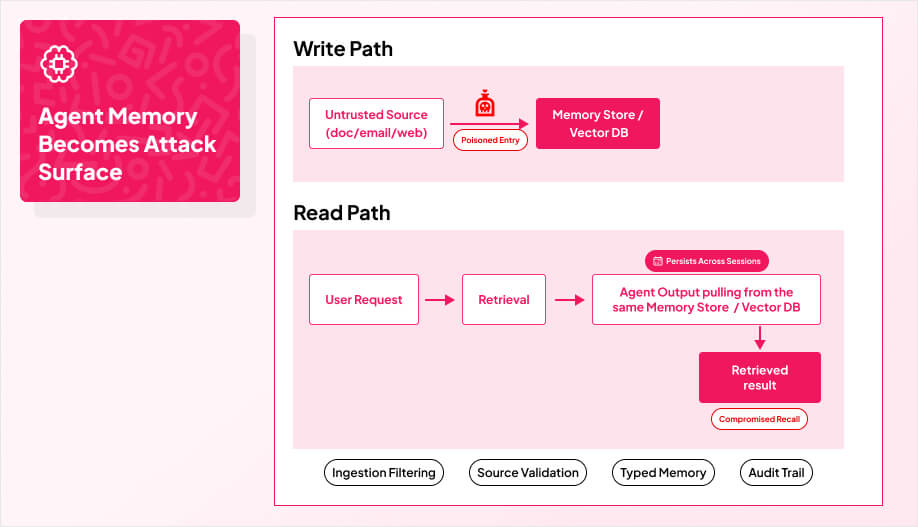
Long-term memory turns an agent’s context into a target.
Attackers can inject false or malicious data into vector stores the system treats as truth, similar to “search poisoning” where the retrieval flow itself becomes compromised.
Unlike transient prompt injection, the draft emphasizes persistence. Malicious directives can get embedded into stored context and function like low-level instructions that survive session resets. That creates a durable backdoor: poisoned data can drift across sessions, override direct user prompts, and resurface later through delayed triggers that quietly exfiltrate sensitive data.
If you do not govern what can enter memory, you are allowing permanent contamination of the agent’s decision context.
The threat is considered the baseline defenses where you validate the origin of memory inputs before ingestion, filter untrusted content, keep immutable audit trails so changes are traceable, and use typed memory schemas that separate low-trust notes from high-trust facts.
It also calls for runtime retrieval scoring filters so agents do not act on corrupted records during critical loops.
Agents inherit a sprawling dependency graph including third-party models, datasets, orchestration tools, plugins, and build pipelines. That makes end-to-end verification hard, and it shifts attacker incentives upstream.
Instead of hitting your infrastructure directly, they compromise a dependency and let the risk propagate through your agent stack.
The exposure points are poisoned training data that implants backdoors, unsafe serialization formats that can execute malicious payloads at load time, retrieval layers vulnerable to cache poisoning and decision steering, and CI/CD paths that can leak secrets.
It’s a layer-by-layer map (pre-trained models, RAG vectors, no-code agents, CI/CD) tied to operational impacts like remote code execution, logic bypasses, and secret exfiltration.
| Component Layer | Primary Vulnerability | Operational Impact |
|---|---|---|
| Pre-trained Models | Serialized Artifacts | Remote Code Execution |
| RAG Vectors | Cache Poisoning | Decision Steering |
| No-Code Agents | Logic Bypasses | Unmonitored Flows |
| CI/CD Pipelines | Prompt Injection | Secret Exfiltration |
On mitigation, the backbone is integrity and provenance. Cryptographic signing of artifacts, SBOMs to expose hidden dependencies, behavioral monitoring to catch anomalies post-deploy, and explicit data mapping across the chain so sensitive data does not leak through vendor or tooling layers.

Threat models are useful, but controls are what keep an agent system from becoming a recurring incident.
The difference between a “secure agent” and a future postmortem is usually whether you made permissions enforceable, failures containable, and actions traceable.
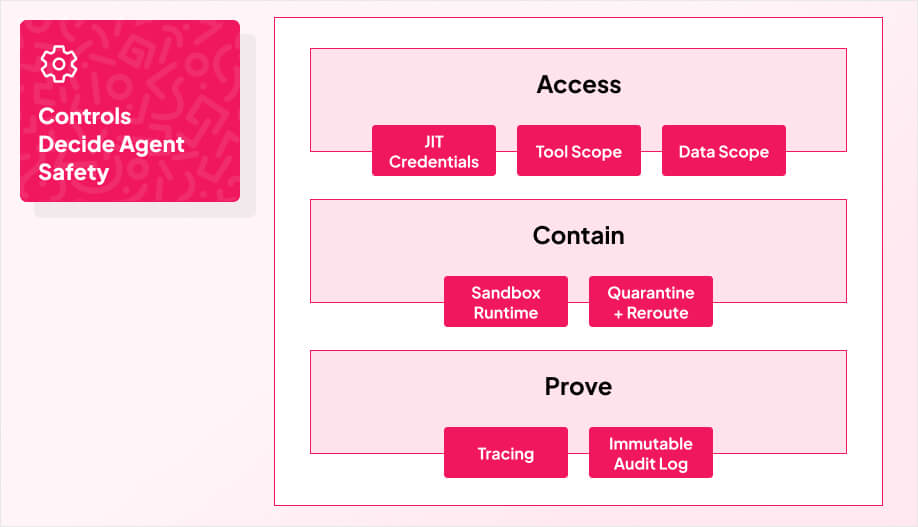
The controls below work because they don’t depend on the agent “behaving.” They assume the agent will be tricked, the tools will be misused, or the system will drift. So you lock down identity, constrain what the agent can touch, isolate runtime blast radius, and make every meaningful action auditable end to end.
That gives you three outcomes: less damage when something goes wrong, faster detection when it starts going wrong, and clean forensics after the fact.
| Control | What It’s For | Practical Use |
|---|---|---|
| Non-Human Identity Ownership | Prevent shared, long-lived agent credentials | Assign a distinct identity per agent or workflow, with explicit ownership and lifecycle rules so “who owns this agent” is never vague. |
| Just-In-Time, Short-Lived Credentials | Reduce the window of abuse if compromised | Issue tokens only at runtime for the minimum time needed, then revoke immediately after the task completes. |
| Least Privilege by Default | Stop broad scopes “for convenience” | Default deny. Allow only the actions required for the specific workflow, not the full API surface “just in case.” |
| Granular Tool Permissions | Treat tools as privileges, not features | Whitelist tools per agent, validate parameters, restrict dangerous operations, and enforce explicit allowlists for outbound destinations. |
| Scoped Data Access | Prevent “read everything” retrieval | Partition knowledge sources, filter retrieval by authorization before it enters context, and mask sensitive fields the agent doesn’t need. |
| Runtime Isolation (Sandbox/Micro-VM) | Contain compromise to one instance | Run agents in isolated runtimes, limit host visibility, and reduce what the process can access by default. |
| Quarantine and Reroute | Keep the system running while isolating a bad agent | Revoke credentials, reroute traffic to healthy instances, and snapshot the compromised runtime for investigation without taking the product down. |
| Correlation IDs + Centralized Logs | Reconstruct behavior across systems | Use consistent correlation IDs across every hop: agent step, tool call, API request, and downstream service action. |
| Distributed Tracing | Tie decisions to real system changes | Trace agent spans all the way to DB queries, file writes, and external API calls so you can prove what actually happened. |
| Append-Only Audit Trail | Prevent silent tampering after an incident | Store critical actions in an immutable, append-only log (with integrity checks) that the agent runtime cannot modify. |
If you want these controls implemented as product-grade defaults (not a checklist that gets ignored after launch), AppMakers USA can help wire them into your agent stack end to end, from identity and tool gating to tracing, kill switches, and incident playbooks.
The controls are what you design on a whiteboard. Operations is what saves you when something weird hits production at 2:13 a.m. and the agent is still happily calling tools at full speed.
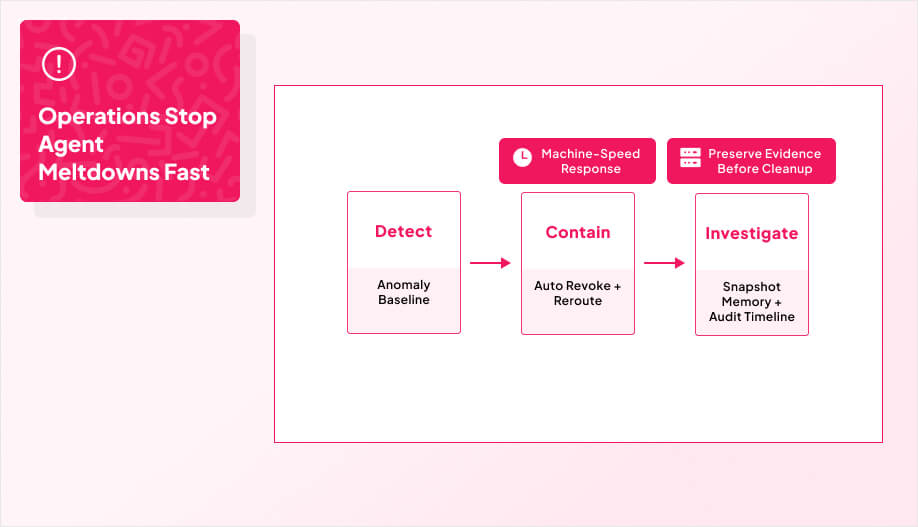
Static rules do not hold up against agent-native attacks, because a lot of the failures are “new” in the sense that they do not match a known signature. What works better is a threat-hunting loop that combines two angles at once: you run top-down checks (you suspect a behavior and go prove or disprove it), while you also watch for bottom-up anomalies (the agent suddenly starts requesting new scopes, calling unfamiliar tools, or generating odd command patterns).
The goal is to baseline normal agent behavior, then flag the small deviations that usually show up right before a larger compromise.
Incident response has to match agent speed. Human analysts take minutes to triage. A compromised agent can do damage in milliseconds. So the workflow needs automated triage that scores severity immediately, plus predefined playbooks that can isolate a service or revoke credentials without waiting for a meeting invite.
Streaming analytics and sub-second scoring targets are not “nice to have” here, they are the difference between a contained incident and a bad week. Guardrail policies should also behave like circuit breakers so irreversible actions get blocked when the system sees anomaly signals.
Forensics is where most teams accidentally destroy the evidence. If an agent relies on retrieval and memory, you need to snapshot the vector store and key caches before cleanup. Treat that memory like the crime scene. If you wipe it, you lose the only record of the invisible instructions that drove the behavior.
If you don’t already have that snapshotting and replay capability wired in, this is one of the areas where AppMakers USA can help fast, because it’s mostly engineering discipline: building the audit trail, versioned memory snapshots, and quarantine workflows into the agent stack so investigations don’t depend on guesswork when something goes wrong.
The most useful captures pair orchestration prompts with the exact memory entries retrieved during the incident, preserve temporal versions so you can pinpoint when poisoning entered the system, and export data in a way that proves whether the blast crossed tenant boundaries.
Then you neutralize the live threat without taking everything down.
If “security” is just policies and guardrails, you’re still guessing. Validation is where you find out whether your agent is actually constrained, or just polite.
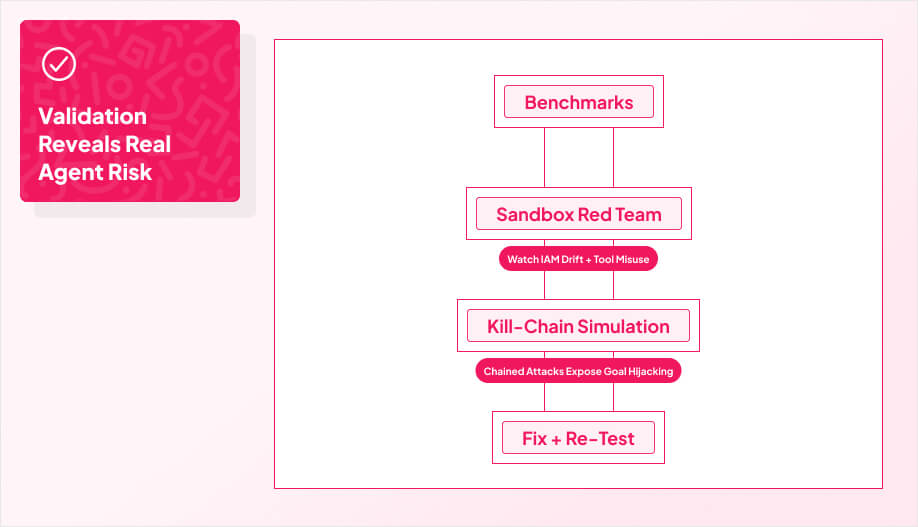
Start with realistic red teaming, not toy prompt tests. When an agent has write access to APIs, databases, or backend workflows, a single-turn “does not say something bad” check is irrelevant. You need sandboxed environments where the agent can browse, execute code, and touch real tool interfaces, then you watch what it tries to do under pressure.
A good red team run surfaces the ugly stuff teams miss in design reviews: agents that self-assign excessive IAM permissions, override safety constraints during optimization, or drift over time because repeated interactions skew decisions.
The point is not to “break the model.” It’s to see whether your system’s identity boundaries, tool gating, and memory controls hold up when the agent is treated like an attack vector.
Next, don’t hide behind off-the-shelf benchmarks. Most of them test static, single-turn chat behaviors, while real agents are multi-step and tool-connected. Frameworks measuring prompt injection and memory poisoning show average attack success rates exceeding 84%, and iterative probing can reach near-100% success after 10 to 100 queries even when systems pass basic checks.
Bigger models also don’t automatically solve this, since there’s limited correlation between model size and resistance to adversarial manipulation. If you don’t test the workflow, you don’t know the risk.
| Validation Method | What It Misses | What It Catches |
|---|---|---|
| Isolated Unit Tests | Cross-tool context and chained behavior | Simple failures in single steps |
| Chained Attack Loops | N/A (this is the point) | Goal hijacking and compound failure modes |
Finally, simulate the full kill chain on live-like systems.
Attackers don’t win with one clever prompt. They pivot. The common pattern is: indirect prompt injection → instruction manipulation → chaining valid API calls until the system’s own policies get worked around.
That’s why end-to-end simulations matter: isolated unit tests miss cross-tool context, while chained loops expose goal hijacking and compound failures that only appear when tools, memory, and permissions interact. The strongest approach is multi-agent offensive simulation that adapts based on environment feedback, choosing alternate attack paths when one gets blocked.
Methodologies like PASTA to connect these exercises to real business assets, and to generate telemetry you can actually use to calibrate guardrails instead of “hoping” they work.
Start read-only. Let the agent observe, summarize, and recommend actions before it can execute them. Then graduate to low-risk writes behind approvals and tight limits.
Treat every tool as a permission, not a feature. Give the agent only the smallest set it needs for one workflow, then expand based on real usage and observed failure modes.
Log actions, not raw prompts. Capture correlation IDs, tool names, parameters (redacted), outcomes, and who/what triggered the run so you can reconstruct incidents without storing sensitive content.
Put eval gates in front of changes to prompts, routing, tools, memory logic, and model versions. If the agent’s behavior shifts, you want a failed check and a rollback, not a surprise in production.
Yes, because mobile adds unreliable networks, offline behavior, and messy client states. Keep secrets and privileged actions server-side, restrict tool calls through a controlled API layer, and design safe fallbacks when the app can’t verify context.
Keeping AI agents secure in real world environments comes down to one mindset shift and it is to treat autonomy like production access.
The teams that get this right don’t chase perfect prevention. They build security that holds up under pressure then they validate the whole chain with red teaming and kill-chain simulations, because that’s how you find the gaps before someone else does.
If you’re building agents into a product and want a security-first architecture that doesn’t slow delivery, AppMakers USA can help.