What to look for when hiring an app rescue service is not just technical skill. It is whether the team can step into a messy, high-risk situation, figure out what is actually wrong, and stabilize the product without creating new problems in the process.
That matters because rescue work is different from building something from scratch. You are handing over a live product, existing users, and often a codebase that already carries stress, uncertainty, or missed deadlines. The wrong agency will give you vague reassurance. The right one will bring a clear process, honest answers, and a plan you can trust before they touch anything important.
Below are the questions you want to ask yourself and this agency you are hiring.
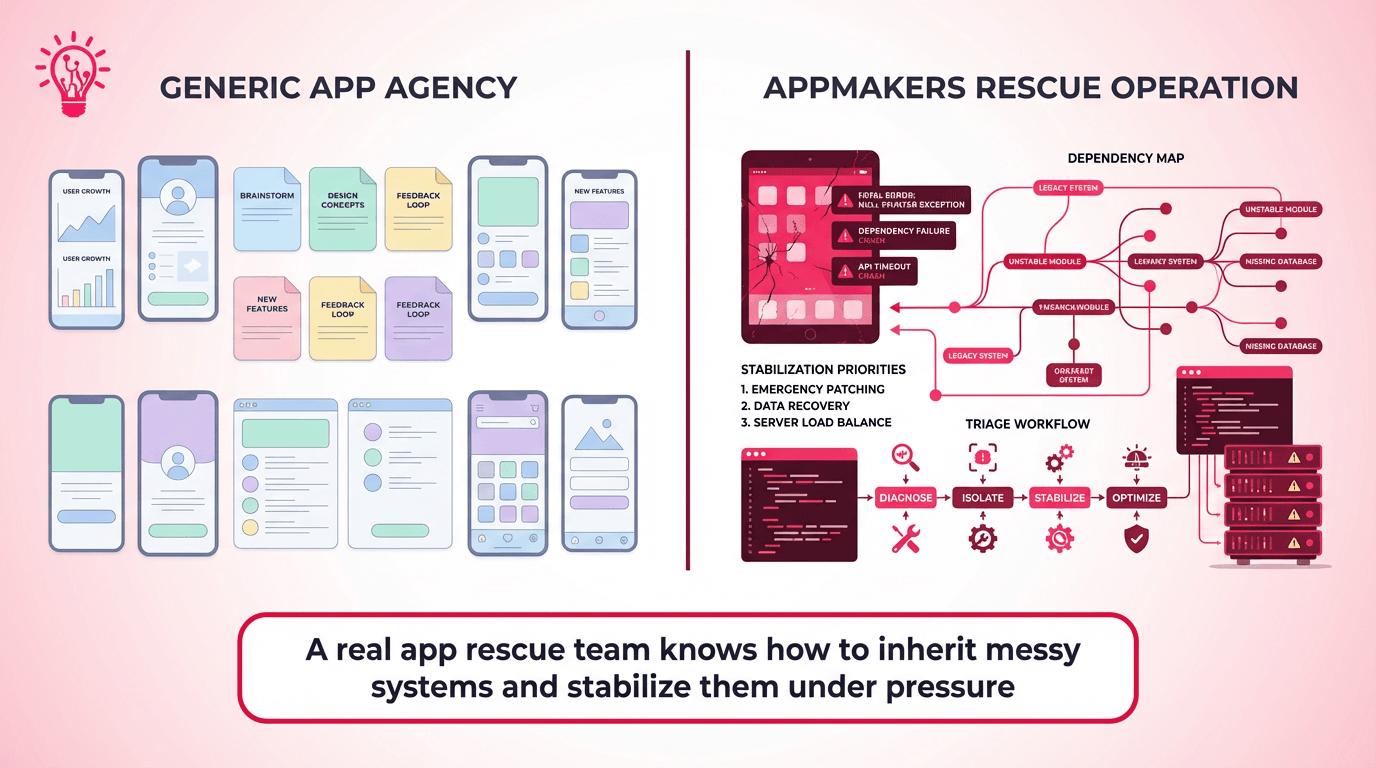
When an app starts crashing, missing deadlines, or becoming harder to trust, you are not hiring a general development team. You are hiring a team to step into a live problem, diagnose what is wrong, and stabilize a product the business already depends on. That is a different job from building something from scratch.
That is why the first question should be whether app rescue is truly a core service or just something the agency occasionally agrees to take on. A serious rescue team should be comfortable inheriting other people’s code, working inside legacy stacks, and making decisions in production without creating more risk than they remove.
That level of specialization matters because troubled software projects are rarely small problems. McKinsey found that half of all large IT projects massively blow their budgets, and that software projects carry the highest risk of cost and schedule overruns.
So when you are evaluating an agency, ask direct questions.
Do they regularly take over projects mid-flight?
Do they have a clear process for stabilizing live apps?
Can they show examples of inherited products they repaired instead of simply rebuilt?
Those answers will tell you a lot faster than broad claims about being “full-service.”
A serious app rescue partner should make you feel that they have seen this kind of mess before and know how to work through it in a controlled way. That is what our Fix Your App service is built around.
Our senior engineers regularly inherit codebases from disappeared freelancers, offshore agencies that walked away mid-build, and AI coding tools like Cursor, Bolt, and Lovable that produced something that looked finished but never was. Rescue is not a side project for us. It is one of the core problems our 50+ person Los Angeles team works on every week. If rescue sounds like an edge case in an agency's business, it probably will become one in yours too.
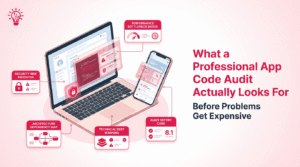
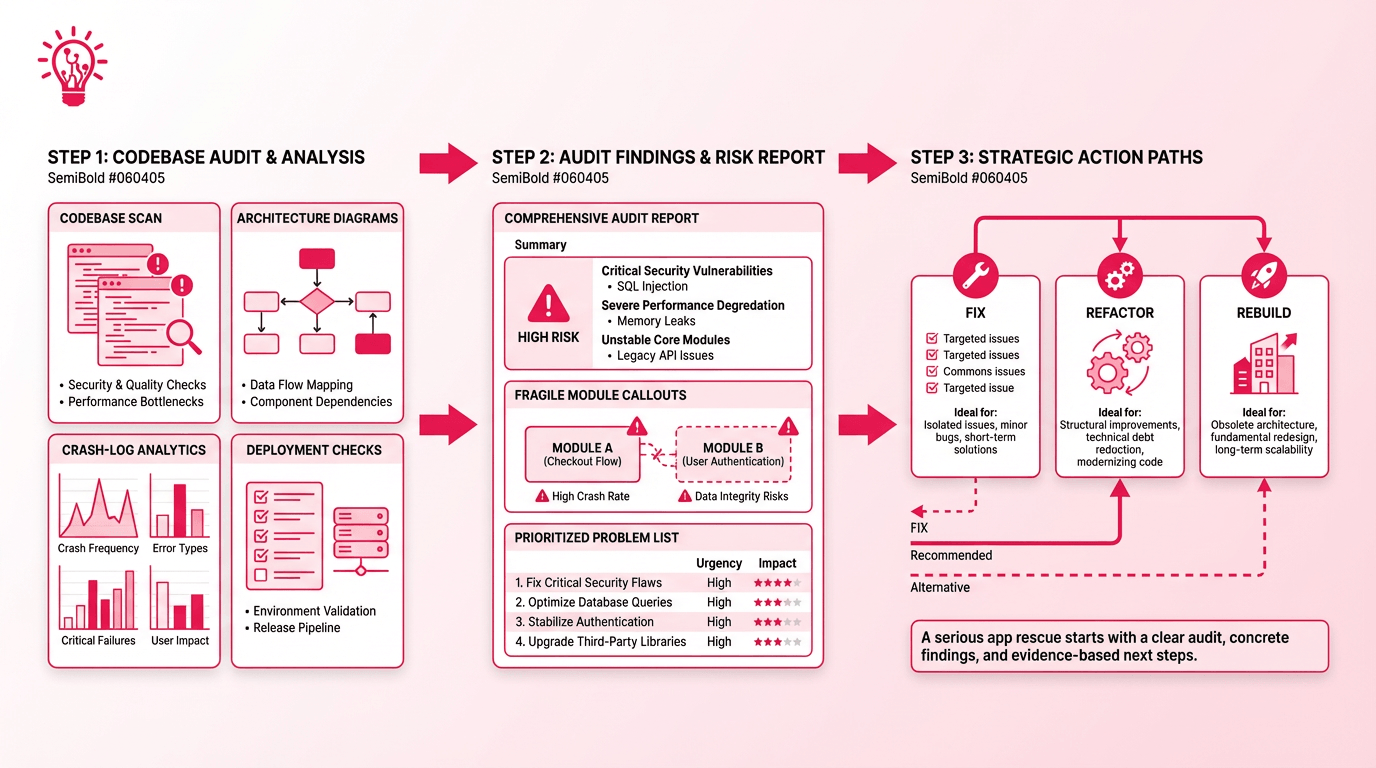
Before anyone touches the code, a serious app rescue should start with a structured audit. The goal is to figure out what is actually broken, how risky it is, and what is worth fixing before development starts.
The first part is the review itself. A good rescue team should examine the codebase, dependencies, architecture, error logs, crash reports, analytics, and deployment setup. Just as important, they should connect that technical review to the business: which user flows matter most, where the product is losing trust, and which failures are doing the most damage right now.
In markets like Los Angeles, where tech investment is especially strong in areas like AI and cybersecurity, those pressures often shape rescue priorities and the tooling teams bring into the process.
The second part is the findings. You should expect something concrete, not vague reassurance. That usually means a written summary of what they found, a prioritized risk list, and a clear explanation of where the app is fragile, what is causing the most pain, and which parts of the system need immediate attention.
The third part is decision-making. A real audit should help you choose between fixing, refactoring, or rebuilding specific parts of the product. It should not jump straight to code, and it should not jump straight to “rebuild everything” either. The point is to reduce guesswork before the rescue begins, so the plan is based on evidence instead of instinct.
If an agency cannot walk you through that process clearly, they are probably not ready to take over a troubled app in a controlled way.
The audit process described above is exactly how our Fix Your App engagements start. A senior engineer from our Los Angeles team, one who has audited inherited codebases across iOS, Android, and web, reviews the codebase, dependencies, error logs, and deployment setup, then gives you a written summary, a prioritized risk list, and a clear recommendation on what to fix, refactor, or rebuild. You get the findings within 48 hours. The initial audit is free.
Before anyone touches the code, a serious app rescue should start with a structured audit. The goal is to figure out what is actually broken, how risky it is, and what is worth fixing before development starts.
The first part is the review itself. A good rescue team should examine the codebase, dependencies, architecture, error logs, crash reports, analytics, and deployment setup. Just as important, they should connect that technical review to the business: which user flows matter most, where the product is losing trust, and which failures are doing the most damage right now.
In markets like Los Angeles, where tech investment is especially strong in areas like AI and cybersecurity, those pressures often shape rescue priorities and the tooling teams bring into the process.
The second part is the findings. You should expect something concrete, not vague reassurance. That usually means a written summary of what they found, a prioritized risk list, and a clear explanation of where the app is fragile, what is causing the most pain, and which parts of the system need immediate attention.
The third part is decision-making. A real audit should help you choose between fixing, refactoring, or rebuilding specific parts of the product. It should not jump straight to code, and it should not jump straight to "rebuild everything" either. The point is to reduce guesswork before the rescue begins, so the plan is based on evidence instead of instinct.
If an agency cannot walk you through that process clearly, they are probably not ready to take over a troubled app in a controlled way.
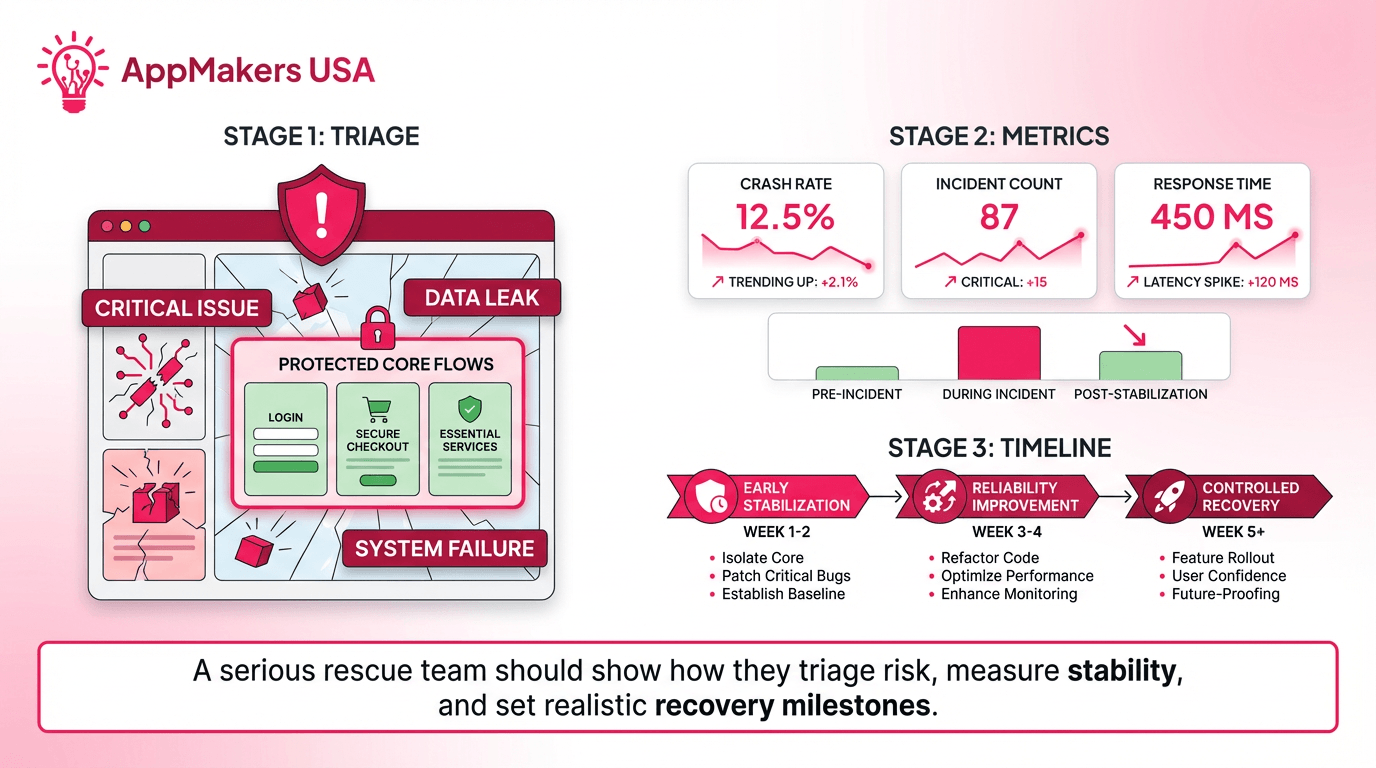
If an agency talks confidently about speed but cannot show how they triage risk, measure stability, or set realistic milestones, that is usually a warning sign. In rescue work, fast only matters if it is also controlled.
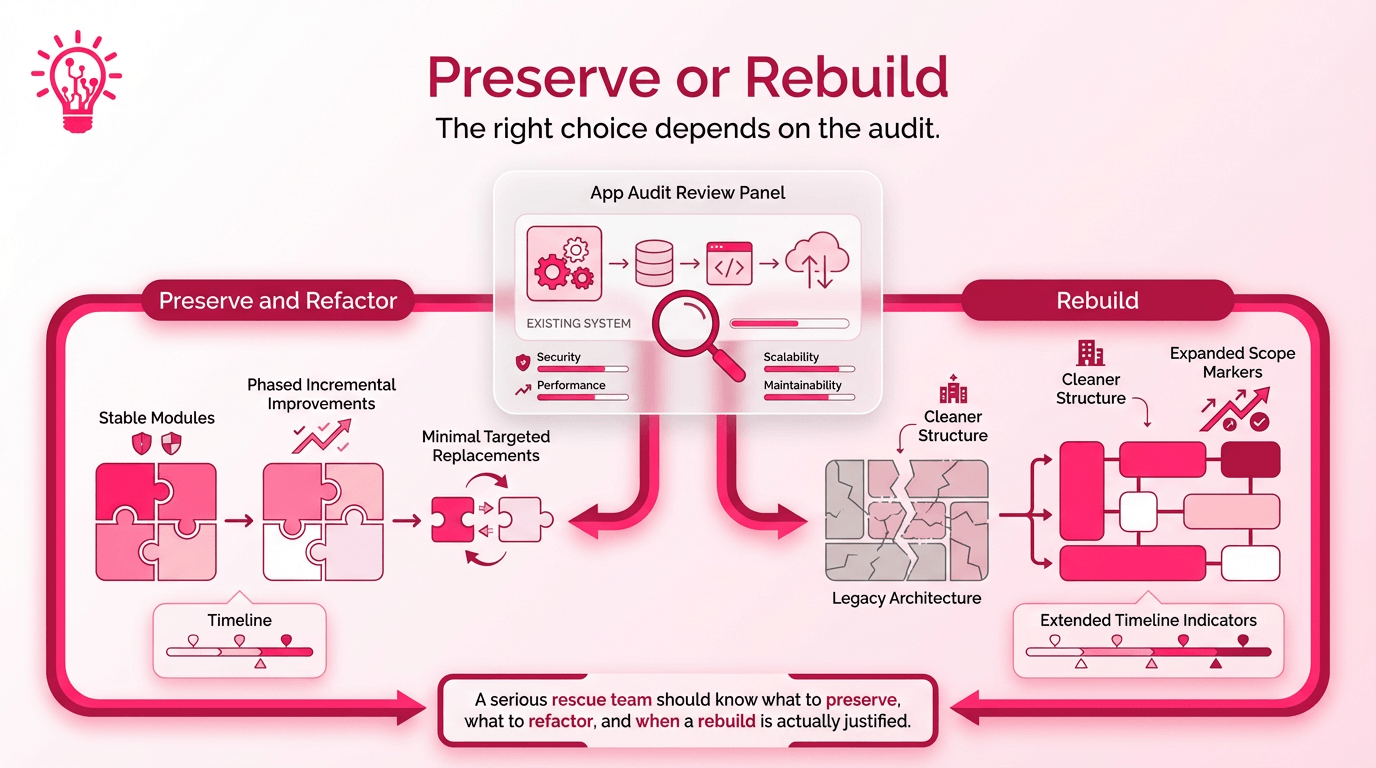
A serious app rescue team should not walk in assuming the whole product needs to be rebuilt. The first job is to figure out what is still working, what is risky, and what can be stabilized without creating more disruption than necessary.
That is why this question matters so much. Some agencies default to rebuilds because it is cleaner for them. A stronger partner will explain the tradeoffs. Preserving parts of the existing stack can shorten recovery time and reduce disruption if the foundation is still usable. Rebuilding may make sense when the architecture is too brittle, the stack is outdated, or the product cannot realistically grow without deeper structural change.
There is a practical reason to be skeptical of an instant "rebuild everything" answer. AWS Prescriptive Guidance notes that about 70% of workloads can typically be rehosted, relocated, or replatformed, which is a useful reminder that many systems can be improved in phases instead of being thrown away outright.
So ask the agency how they decide.
What do they look at before recommending a rebuild?
What would they preserve if it is working?
Can they show examples of projects where they kept the right parts, replaced the wrong ones, and moved the product forward without restarting from zero?
Those answers tell you whether they are making an engineering decision or just selling the biggest possible scope.
This is also where broader custom mobile product work becomes relevant. Sometimes the right answer is not a full rescue or a full rewrite, but a phased plan that preserves what still has value and rebuilds the parts that are holding the product back.
That kind of work sits much closer to long-term product development than emergency patching, which is why it matters who is making the call.
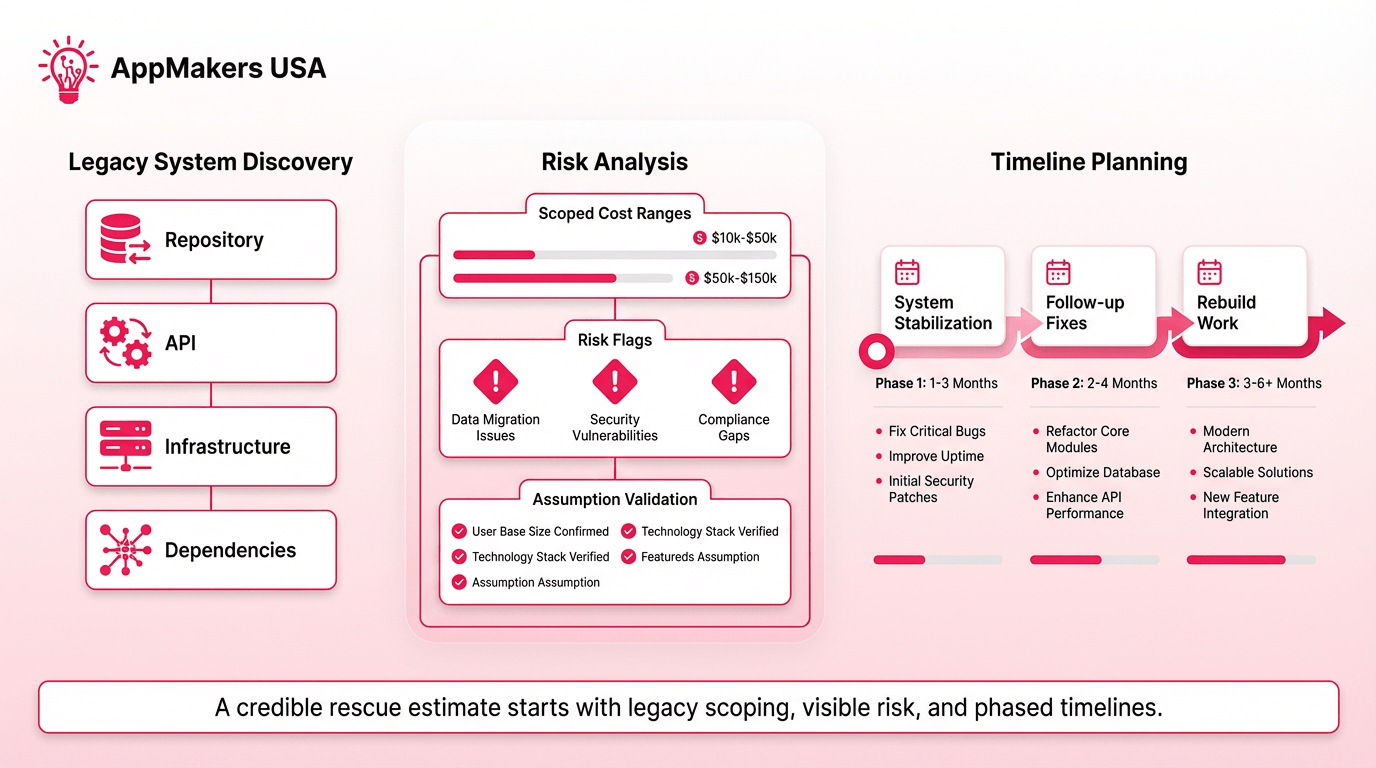
A serious app rescue estimate should start with one thing: a clear read on what the agency is actually inheriting.
Rescue work is different from pricing a fresh build because the biggest risks are usually hidden inside old code, undocumented decisions, brittle integrations, and deployment setups nobody fully trusts anymore. That is why a real estimate starts with scoping the existing system before anyone pretends they know the full price or timeline.
The first part is legacy scoping. A strong rescue partner should be able to explain how they review the codebase, modules, APIs, third-party services, infrastructure, and deployment flow before turning that into numbers. You want them to identify the known problems, but also the unknowns that could change scope later, like abandoned libraries, missing documentation, or fragile hotfixes the team has been living around. If they skip that step, the estimate is resting on confidence, not evidence.
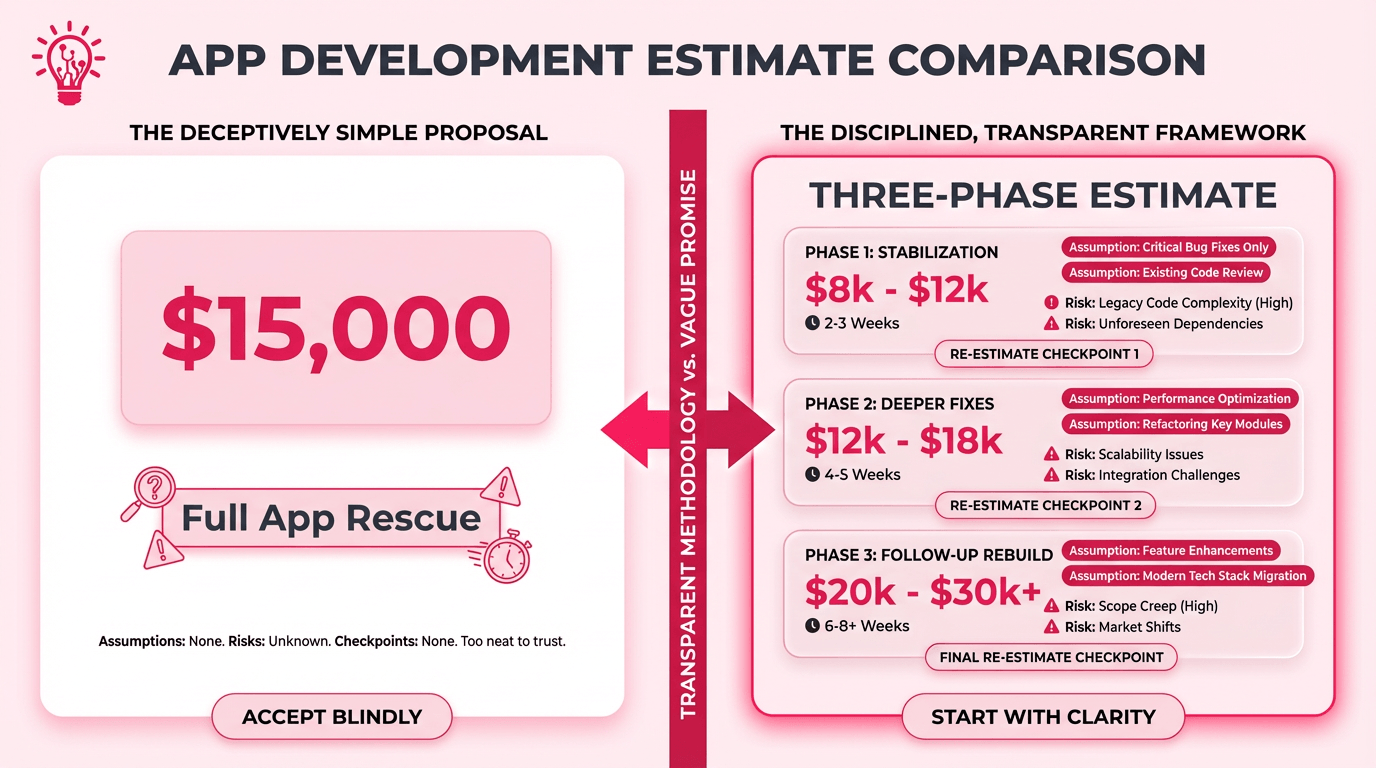
The second part is budget and risk logic. Rescue work should usually be priced in phases, not as one overly certain promise. A good agency should explain what is included in the first stabilization phase, what assumptions they are making, where the biggest risk sits, and how they will re-estimate once they learn more. That matters because software projects are notoriously hard to estimate cleanly. McKinsey reports that large IT projects run 45% over budget on average and 7% over time, while delivering 56% less value than predicted.
The third part is timeline expectations. You should hear a difference between immediate rescue work, short-term stabilization, and the deeper follow-up work that may come later. In other words, what can realistically be fixed fast, what needs a second phase, and what should wait until the product is no longer in recovery mode.
Good estimates do not remove uncertainty. They make it visible and manageable.
Workflow cleanup and automation often become relevant here too. If part of the cost is coming from brittle handoffs, repetitive manual work, or operational friction around the app, a strong rescue partner should be able to spot that early and factor it into a more realistic plan rather than treating the codebase in isolation.
That kind of scoped, phased estimate is what Fix Your App delivers: real numbers, named assumptions, and a re-estimation point built into the engagement instead of one oversized rebuild quote.
The patterns we see (abandoned dependencies, undocumented hotfixes, integrations the original team built around instead of through) are familiar territory at this point, which is why we can usually price the first phase confidently and flag the riskier unknowns up front.

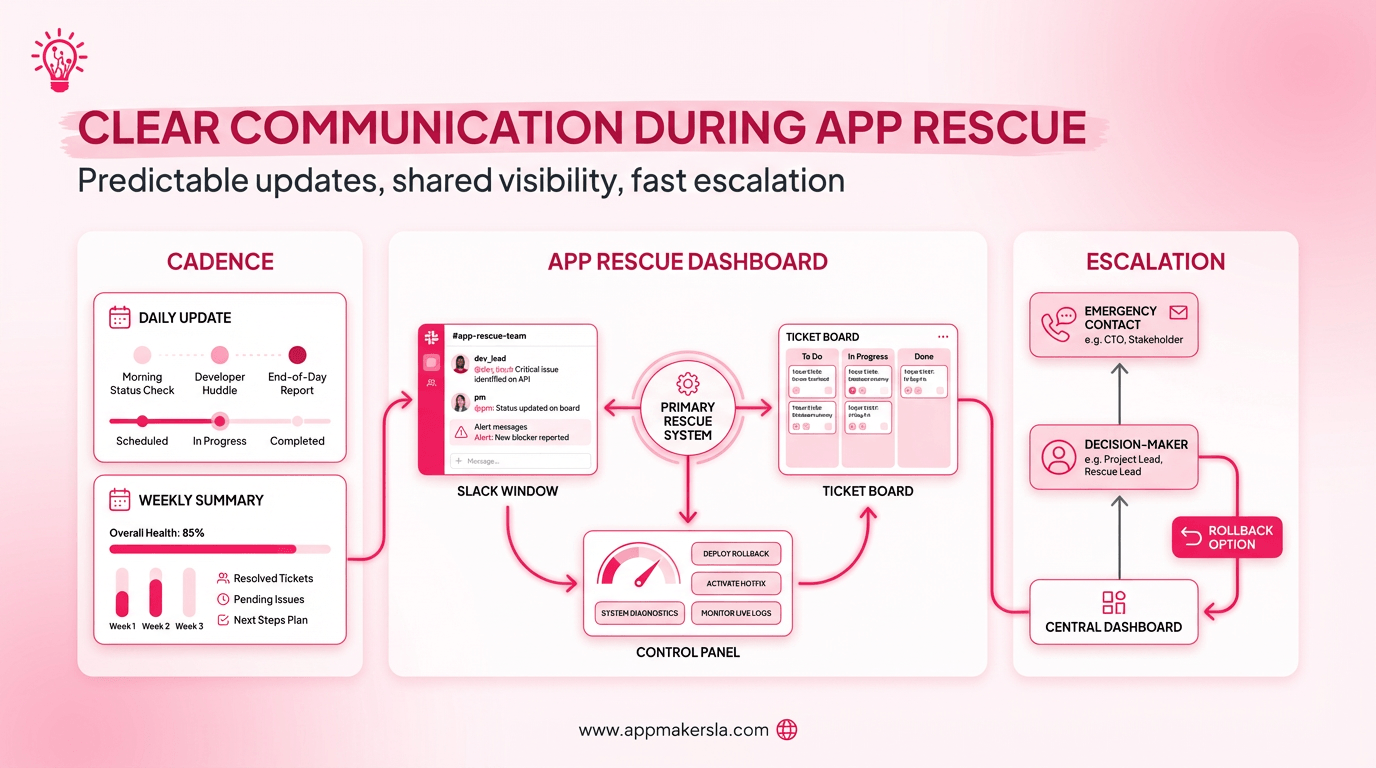
In an app rescue, communication is not a nice extra. It is part of the rescue itself.
When the product is unstable, silence creates more risk. You need to know how often the team will update you, what those updates will include, and what happens when something goes wrong outside normal hours.
Start with cadence. A serious rescue partner should be able to tell you exactly how communication will work during the high-risk phase. That usually means a predictable rhythm for day-to-day updates, a clear format for leadership summaries, and a way to surface blockers before they turn into bigger problems. If the answer is vague, the rescue process probably will be too.
Then ask about channels. You should know which tools will be used for quick decisions, status tracking, tickets, and urgent issues. The point is not to create more noise. It is to make sure the right people can see what is happening without chasing updates across five places.
Finally, ask about escalation. Rescue work gets risky when nobody knows who decides what under pressure. A strong team should be able to explain who gets notified when production issues flare up, how fast they respond, and who owns the call if a rollback or emergency fix is needed.
Good communication during rescue should make the situation feel more controlled, not more chaotic. You are not just hiring developers to fix a product. You are hiring a team that can keep the business informed while they do it.
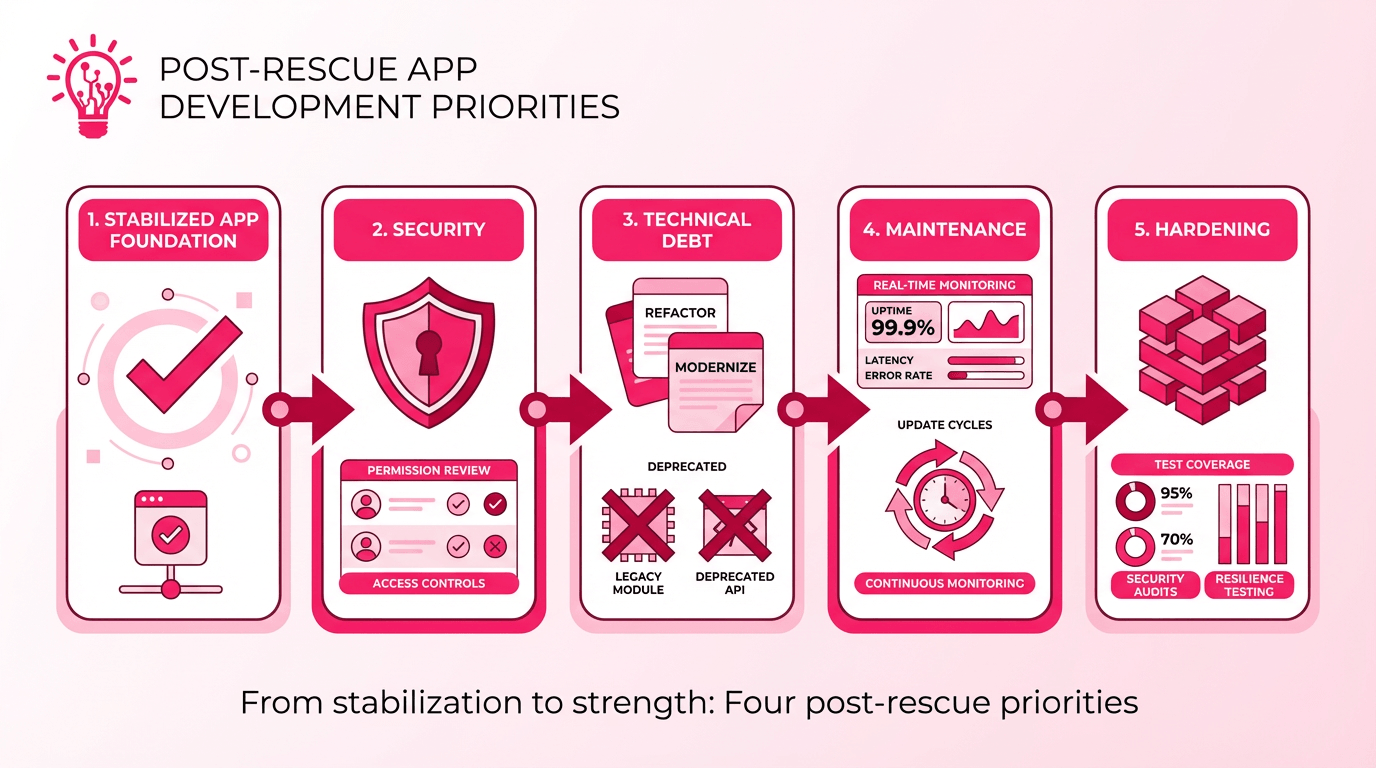
Getting the app stable again is only the first phase. Stabilization stops the immediate damage. It does not automatically fix the deeper problems that put the product in trouble in the first place.
Once the urgent issues are contained, the next step is to make sure the product is not still exposed. That means reviewing dependencies, permissions, secrets handling, and the parts of the system that may have been patched quickly under pressure. A serious rescue team should be able to explain how they move from emergency fixes into a more disciplined security review, so the app is not left running on temporary decisions.
Stabilization often reveals how much fragile code, outdated libraries, missing tests, and rushed architecture the team has been working around. That debt needs to be documented and prioritized. The right partner should show which items are urgent, which are slowing future development, and which can wait until the product is in a stronger position.
A rescued app can slip back into trouble if nobody owns the follow-through. Maintenance is what keeps small issues from turning into another rescue later. That includes monitoring, routine updates, bug follow-up, and making sure the product is still behaving well once real usage continues.
This is the part many agencies skip. Hardening means turning a recovered app into one that is more resilient than it was before. That usually includes cleaner testing practices, better visibility into failures, more reliable release habits, and fewer fragile points that can break under pressure. The goal is not just to get the app working again. It is to make sure the next problem does not put the business back in the same position.
This is where the right rescue partner stops feeling like a crisis vendor and starts feeling like a team that protects the business long after the immediate fire is out.
Fix Your App was built to cover both phases, stabilization first and hardening second. A senior engineer from our Los Angeles team handles the immediate triage, then walks the codebase through the security review, technical debt cleanup, and hardening work that keeps the rescue from unraveling later. The rescues that hold are the ones where the team kept going past "the app is up again" until the next problem became unlikely instead of imminent. You get a phased plan with named milestones instead of one open-ended retainer.

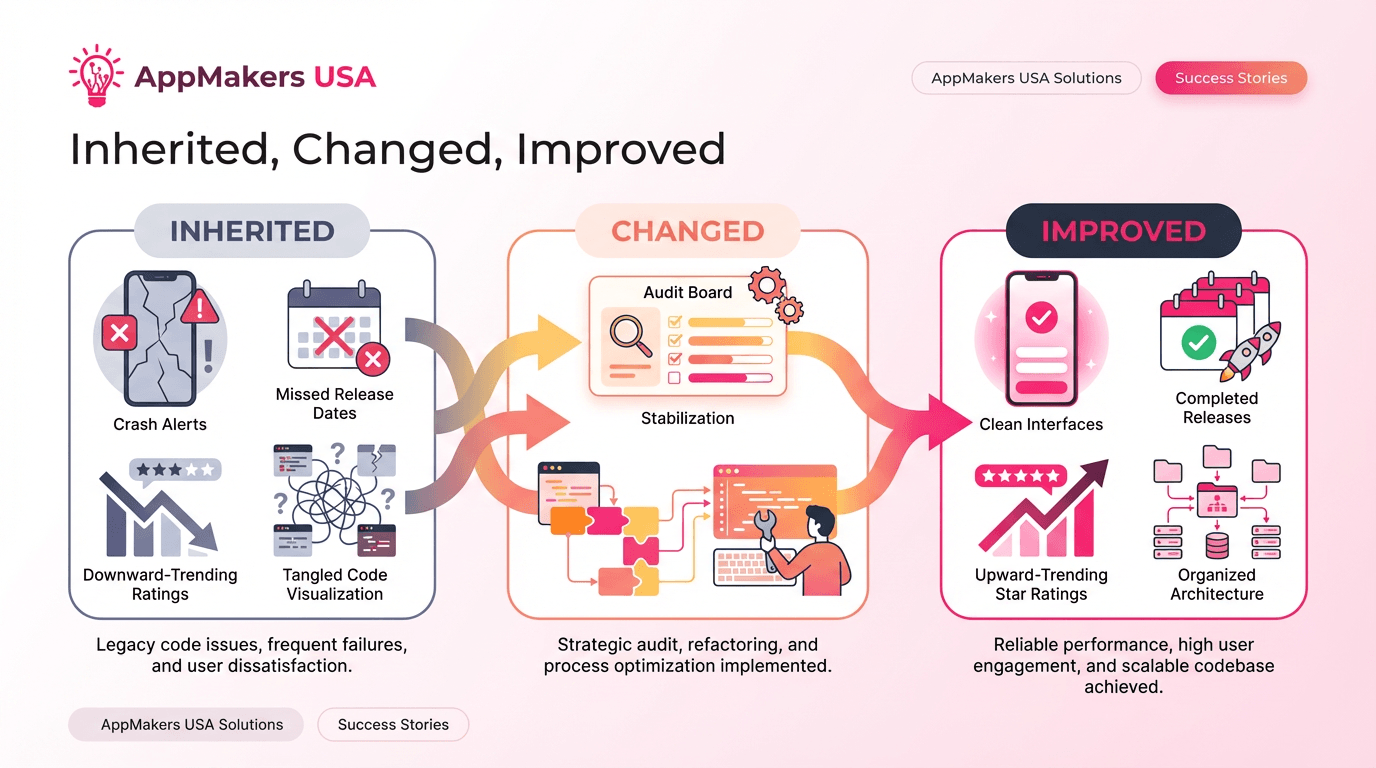
You should not have to take an agency's word for it. If they really know how to rescue apps, they should be able to show what they inherited, what they changed, and what improved afterward.
The strongest proof is not a polished portfolio page. It is a case study that shows the starting condition clearly. What was broken? Was the app unstable, delayed, unscalable, or stuck on a weak stack? What kind of product was it, and how close is that situation to yours?
Then look at the intervention itself. A serious rescue partner should be able to explain how they approached the handoff, how they stabilized the product, and which technical or operational decisions made the biggest difference.
You want specifics, not vague language about "optimizing performance" or "improving UX."
The last thing to look for is a measurable outcome. That could be fewer crashes, better release stability, stronger retention, improved app store ratings, or a product that could finally support new growth again. The point is not that every rescue needs the same metric. The point is that the agency should be able to tie its work to visible change.
Relevant examples matter too. A rescue team does not need your exact business model, but they should be able to show they have worked through similar pressure, whether that means live users, fragile infrastructure, compliance needs, or a product that had already lost trust internally.
If they cannot connect past rescue work to your kind of risk, expect a learning curve you will probably pay for.
Not always. It depends on how unstable the product is. In higher-risk situations, pausing non-essential feature work can prevent more damage while the rescue team stabilizes the core app.
They usually need access to the codebase, analytics, crash logs, infrastructure, third-party services, and whoever understands the product history best. Without that, they are working with blind spots from day one.
No. It can also make sense when an app is still live but clearly becoming harder to maintain, slower to improve, or riskier to scale.
Watch for instant rebuild recommendations, fixed quotes with no real discovery, or vague answers about risk. Serious teams explain what they know, what they still need to verify, and why.
You should have one clear decision-maker, fast access to historical context, and a way to approve urgent calls quickly. Rescue work usually goes better when your side is organized too.
Hiring an app rescue service is really a trust decision. You are choosing the team that will step into a stressed product, make calls under pressure, and influence what happens next.
The strongest agencies do not hide behind broad promises. They show a process, explain tradeoffs clearly, and make it easier to see whether your app can be stabilized, repaired, or rebuilt in a way that actually protects the business.
Fix Your App is built around the eight questions covered in this post. A senior engineer from our Los Angeles team audits your codebase, walks you through the stabilization plan, names the tradeoffs honestly, and gives you a phased recommendation you can act on. You get the full report within 48 hours, the initial audit is free, and there is no obligation afterward.
If you are weighing rescue options right now, this is the lowest-risk way to find out where AppMakers USA actually fits before the damage gets more expensive.