Home
Our Process
Portfolio
FAQ
Where can I see your previous work?
Check out our portfolio at AppMakersLA.com/portfolio
What services do you offer?
We are a Los Angeles app and web development company. As such, we offer: 1) Design for Apps, Webapps and Websites 2) Mobile App Development for iPhone Apps, Android Apps and iPad Apps & Web Development for Webapps. Each project includes full QA Services as well as a product manager.
Where are your app developers located?

Our app developers are mainly located at 1250 S Los Angeles St, Los Angeles, CA 90015, though we have other offices around the world, and we hire the best developers wherever and whenever we find them. If having engineers & designers in Los Angeles is critical to the project, we have the resources to make that happen.

How much do you charge for your services?
Our cost varies depending on the project. Please contact us for a mobile app development consulting session and we will get you an estimate + analysis pronto.
Can you build software for startups?
Yes, we consider ourselves a startup app development company, as well as an agency that builds software for already established firms.

Discover 30+ more FAQs
View all FAQs
Blog
About
Phone number copied!
Contact ussms IconCall Icon
We answer our phones!
App Development / Does AI Reduce...

Does AI Reduce App Development Cost? The Honest 2026 Answer

Does AI reduce app development cost? For 2026, the short answer is yes - but only on specific builds. AI can get a simple product off the ground far cheaper than it used to, as long as there is no security concern, no real scale, and no money moving through it. The moment any of those three enters the picture, the cheap path just sends you a delayed bill.

We have seen both sides play out on real projects. On a K-12 education product, AI did genuine, measurable work. On a consumer social app we still maintain, the expensive part was not the visible features - it was the dependency and migration debt underneath. That gap is what this article is about.

What Does "Does AI Reduce App Development Cost" Really Mean for a Buyer?

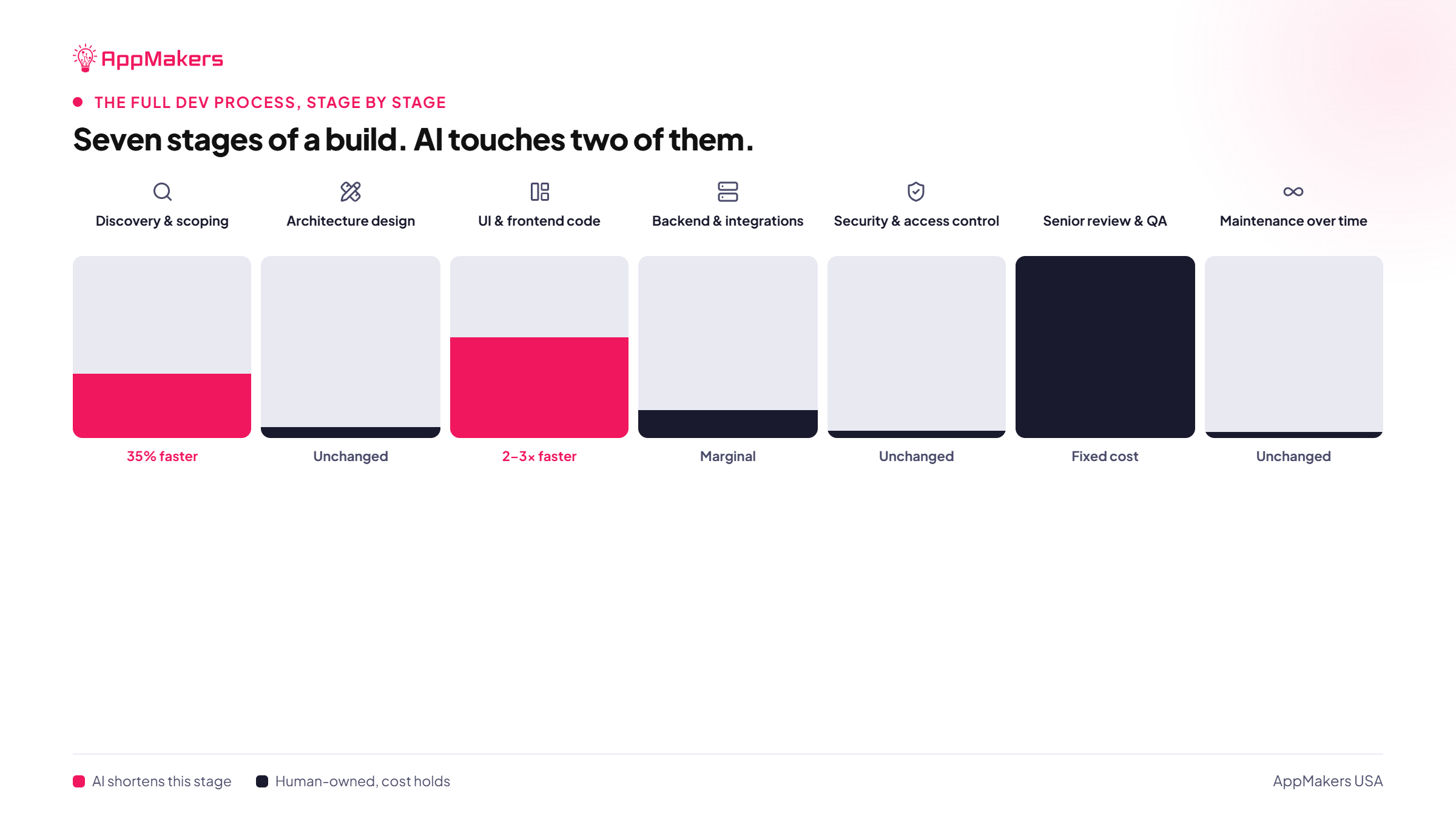
AI speeds up two of the seven stages of an app build

The real question is not whether AI is good. It is whether a quote should drop because an agency uses AI.

Those two questions have opposite answers depending on the build. A founder pricing an app does not need a verdict on AI in the abstract. They need to know if "we use AI" justifies a cheaper number, or if it is a sales line stretched over work that still costs what it always did.

AI app development cost is not one number that moved. It is a stack of cost layers, and AI only touches a few of them. Understanding where the dollars actually go on a real build is what makes that distinction clear.

Think about how you already use these tools. Everyone is using ChatGPT, Claude, and Gemini for small tasks. Most of the time the output is good. About one percent of the time it is just off. That same one percent shows up in code - except in code, the off thing is not a clumsy email. It could be a small bug that does nothing, or one that drains your users' accounts when a certain sequence of events lines up.

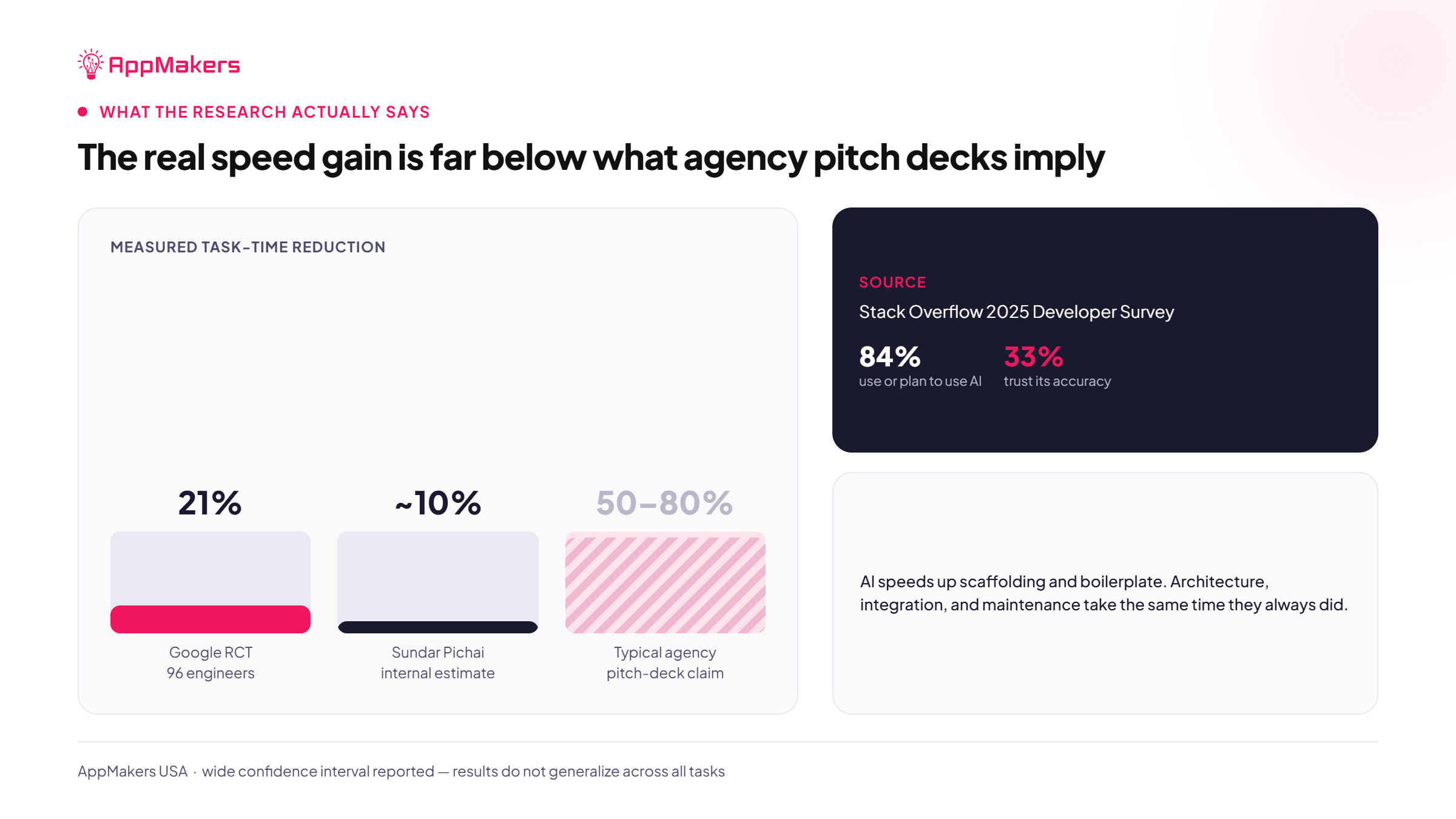
According to Stack Overflow's 2025 Developer Survey, 84% of developers use or plan to use AI tools, yet only 33% say they trust the accuracy of AI output. The gap between adoption and trust is exactly where the cost risk lives. What that unreviewed AI code actually looks like is something most founders only find out after the fact.

AppMakers USA uses AI inside its own development process, so this is not a position against the tools. It is a position about where they can be trusted without a senior engineer reading every line.

What Do the Actual Studies Show AI Does to Developer Speed?

The honest answer is that measuring AI's impact on developer speed is harder than it looks. 

The gains are real on certain tasks and nearly invisible on others - and most agencies are not careful about which category your build falls into. What we have seen across our own builds is that AI speeds up the parts that were never the expensive bottleneck to begin with: scaffolding, boilerplate, repetitive patterns. The hard parts take the same time they always did. Speed is also only half the story. The studies that show AI accelerating builds tend to measure output volume, not the cost of fixing what ships too fast.

The numbers that do exist land far below what agency pitch decks imply. A Google randomized controlled trial of 96 engineers found roughly a 21% reduction in task time, with a wide confidence interval and a specific warning against assuming the result generalizes. Google CEO Sundar Pichai has put his own company's internal velocity gain at around 10% - a CEO estimate, not a research finding, but notable for how far it sits from the 50 to 80 percent some agencies imply.

Here is what that gap looks like in practice. A founder comes in with a quote from an agency that used AI to build a consumer app in six weeks at roughly half the typical cost. The visible product looks solid. The build was fast. Three months after launch, they need to add a payment flow. The engineer who built it cannot extend it cleanly because the AI-generated architecture was never structured to handle transactional logic. What looked like a savings at the invoice stage became a partial rebuild at the feature stage. The fast layer was cheap. The layer underneath it was not built at all.

The pattern across all of it is consistent: AI moves the build faster on certain tasks, and the time saved does not show up where the cost actually lives. Faster keyboards do not shrink architecture decisions, integration work, or years of maintenance. That is the part worth understanding before you evaluate any quote.

Measured AI speed gains of 10 to 21% vs the 50 to 80% agencies claim

Where Does AI Genuinely Cut Cost, and Where Does It Not?

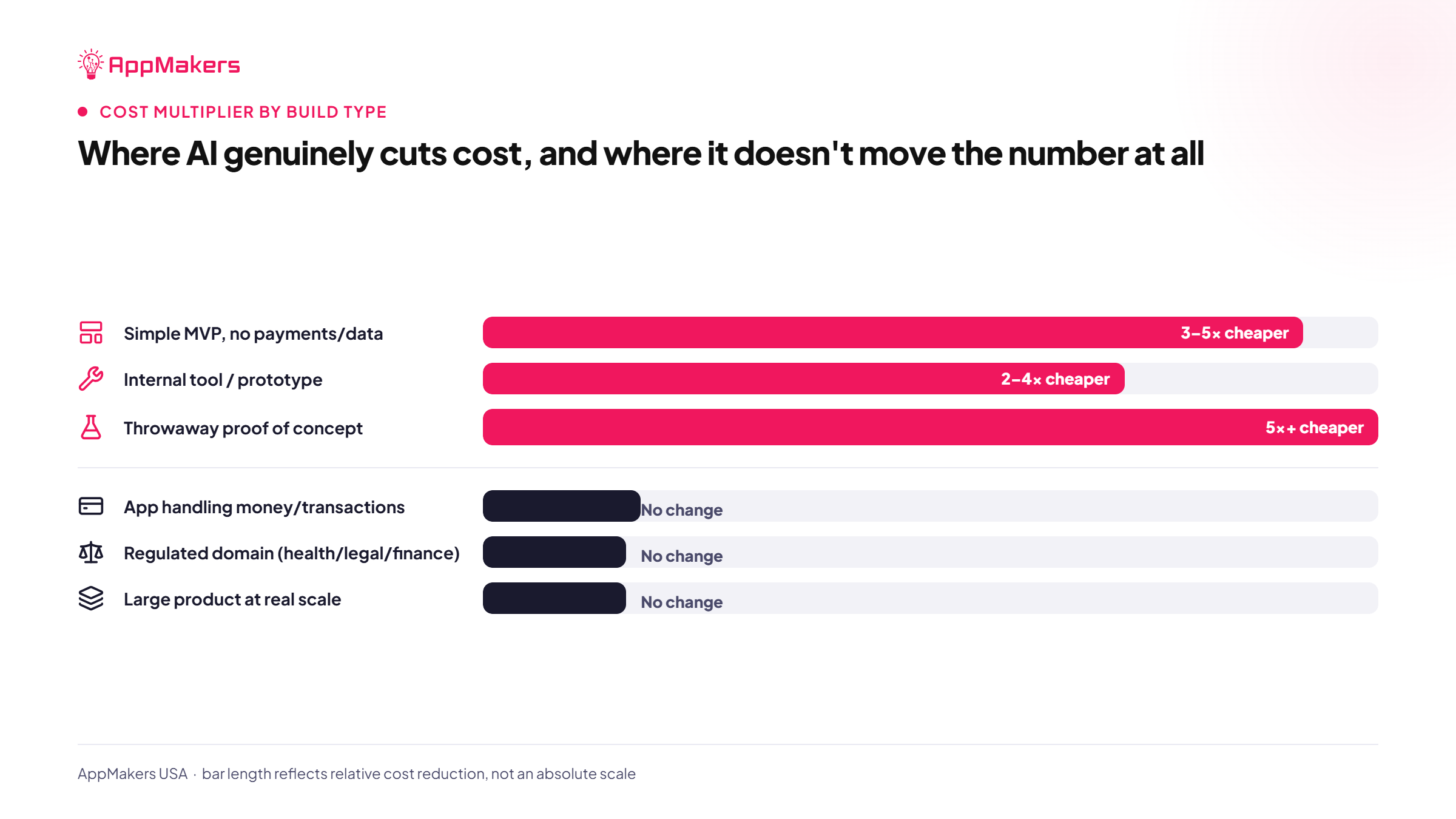
AI cuts cost on simple MVPs and prototypes, but not on regulated or large apps

AI cuts cost on the building layer of a simple product and barely touches the layers that drive most of the bill. The split, as of June 2026, is this: AI is genuinely transformative for getting an MVP off the ground when there is no security concern, no financial transaction, and no real scale. A capable engineer can build that kind of product 3 to 5 times cheaper than before. The cost does not fall because AI replaced the engineer. It falls because a strong engineer using AI well covers ground faster on the parts that were always the most mechanical.

The moment any of those three conditions enter the picture, the math changes entirely.

Where AI Genuinely Cuts the Cost

These are the builds where AI changes the estimate in a real, meaningful way - not because the engineer disappears, but because the mechanical work that used to eat hours now takes minutes.

Build typeTypical savingsWhat AI handlesWhat the engineer still owns
Simple MVP, no payments, no sensitive data3 to 5x cheaperScaffolding, UI components, boilerplate, repetitive logicArchitecture decisions, edge cases, code review, final QA
Internal tool or prototypeLarge savings, varies by scopeLayout, data connections, standard flowsBusiness logic, access control, anything that touches real data
Throwaway proof of conceptFastest and cheapest categoryAlmost everything at the surface levelSomeone still needs to read what shipped before it goes anywhere real
The savings here are real. A founder with a clean, non-sensitive idea and a strong engineer using AI well is in a fundamentally different cost position than they were two years ago. The caveat is that even in this category, an unreviewed AI output is a liability. The engineer is not optional. They are just faster now.

Where AI Does Not Move the Number

These are the builds where "we use AI" should not change the quote in any meaningful way. The expensive work is the part AI cannot be trusted to do alone - and the cost of getting it wrong is not a bug ticket.

Build typeDoes AI cut the cost?What drives the real costWhy AI cannot touch it
App handling money or transactionsNoPayment logic, fraud handling, audit trails, complianceOne wrong assumption can drain accounts. Every line needs senior review, every time
Regulated domain (healthcare, legal, finance)NoSecurity architecture, compliance controls, data handlingAlmost right is catastrophic here. There is no acceptable margin for an AI error
Large product with many featuresNoSystem architecture, integration complexity, cross-team coordinationThe codebase exceeds what any model can hold in context. A senior engineer drives, not the AI
Product at real scaleNoLoad architecture, database design, infrastructure decisionsScaling takes creative problem-solving built on deep system knowledge. No one-button solution exists
Apps with sensitive user dataNoEncryption, access control, data residency, breach responseThe risk of an unreviewed AI assumption in this layer is not theoretical
The pattern across both tables is the same. 

AI cuts the cost of writing code. It does not cut the cost of deciding what to write, integrating it safely, securing it, or maintaining it for years. That is where the bill actually comes from - and it is also where projects succeed or fail.

Most founders only find out which side of that table their build sits on after a team has already quoted them. Getting that read early, before any money moves, is the part that protects the budget. AppMakers USA scopes every project layer by layer, including telling you upfront when AI genuinely changes your number and when it does not. The same senior oversight applies whether the build is a cross-platform product or a native iOS app where platform-specific decisions drive the architecture from day one.

According to Google's 2025 DORA report, while AI now shows a positive relationship with delivery throughput, it continues to show a negative relationship with delivery stability. Faster shipping, shakier production. That tradeoff is invisible in a quote that only prices the build speed.

The founders who get burned are usually the ones who found out which side of that table they were on after the quote was already signed. AppMakers USA has that conversation at the start - what AI actually changes on your build, what it does not, and what an honest number looks like either way.

See how we scope a build →

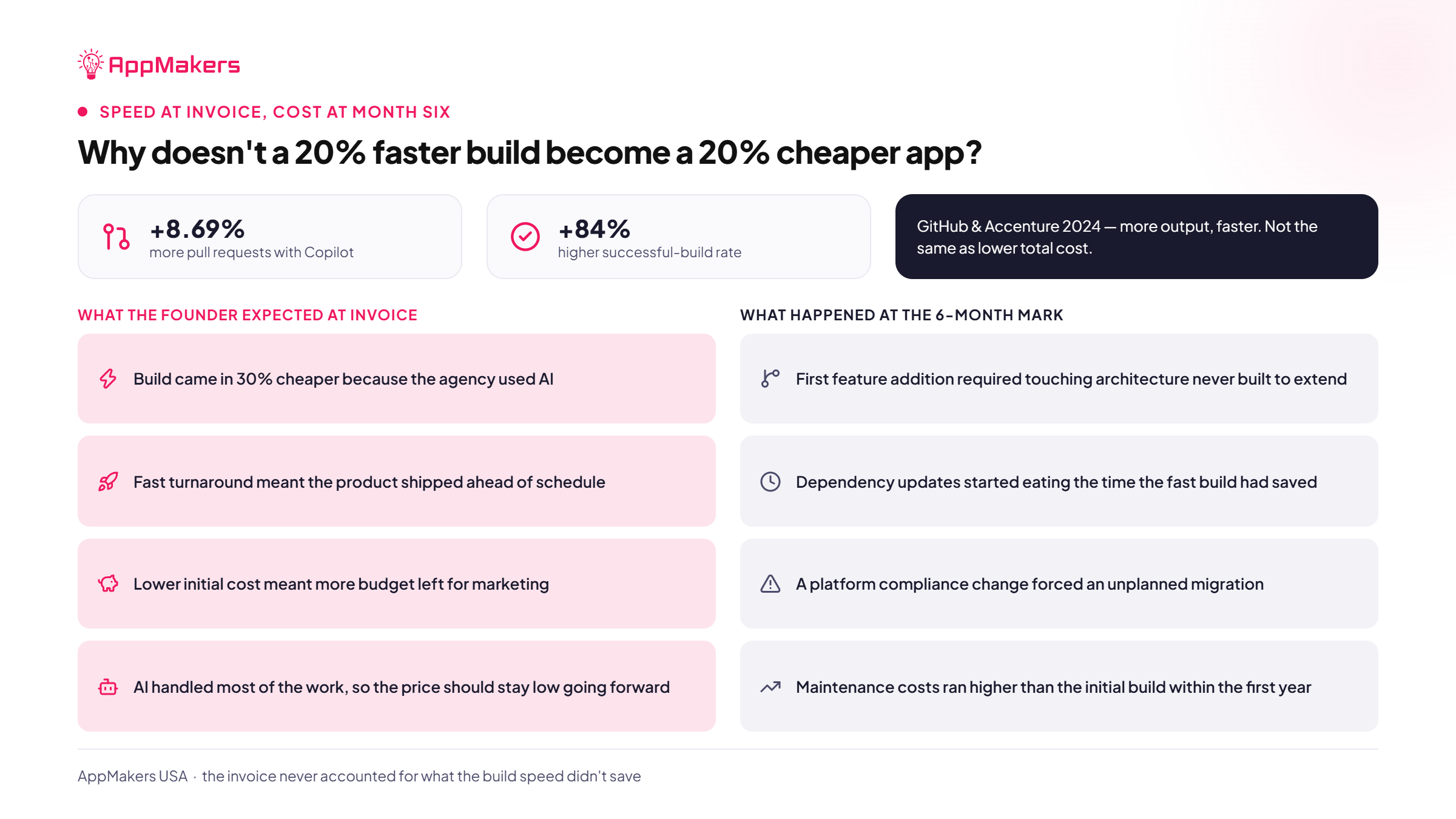
Why Doesn't a 20% Faster Build Become a 20% Cheaper App?

Because the initial build is the part AI helps with, and the initial build is the smallest slice of what an app costs over its life.

A faster keyboard does not shrink architecture decisions, integration work, security review, or the years of maintenance and rework that follow launch. Those layers absorb whatever the build speed saved before it ever reaches your invoice. The GitHub and Accenture 2024 study found developers using Copilot produced 8.69% more pull requests and saw an 84% higher rate of successful builds. More output, faster. But output volume is not the same thing as total cost, and that distinction is where most AI savings claims fall apart.

Here is what that gap looks like from the founder's side:

What the founder expected at invoiceWhat happened at the 6-month mark
Build came in 30% cheaper because the agency used AIFirst feature addition required touching architecture that was never built to extend
Fast turnaround meant the product shipped ahead of scheduleDependency updates started eating the time the fast build had saved
Lower initial cost meant more budget left for marketingA platform compliance change forced a migration the original estimate never accounted for
AI handled most of the work so the price should stay low going forwardMaintenance costs ran higher than the initial build within the first year
The app looked solid and the code shipped cleanA security review before a funding round surfaced gaps the AI output had introduced quietly

The initial invoice reflected the fast layer. Everything that followed reflected the layers underneath it - and those layers were never going to be cheaper because the first one shipped faster.

We saw this directly on a consumer social app we built and still maintain. On the surface it looked straightforward. But a disproportionate share of engineering went into dependency maintenance and framework migration, not the visible features. Our internal reusable UI component layer saved time early, then started costing it as the React Native and Expo ecosystem moved on. The hardest hit came late in Android release prep, when Google Play began enforcing newer memory page-size requirements. Parts of the stack were tied to older native dependencies, and the migration turned painful fast. No AI tool would have prevented that. The cost was structural, not a typing speed problem.

There is also a quieter cost AI introduces on the other side. 

When code ships faster but the review layer thins out, what comes back is bugs to patch, incidents to chase, and rework to fund. That bill lands on whoever built it. It is also exactly what a proper rescue engagement ends up covering when a fast build hits a wall six months after launch.

A 20% faster build still costs more by month six

What Is Snake Oil, and What Is Reasonable to Hear From an Agency in 2026?

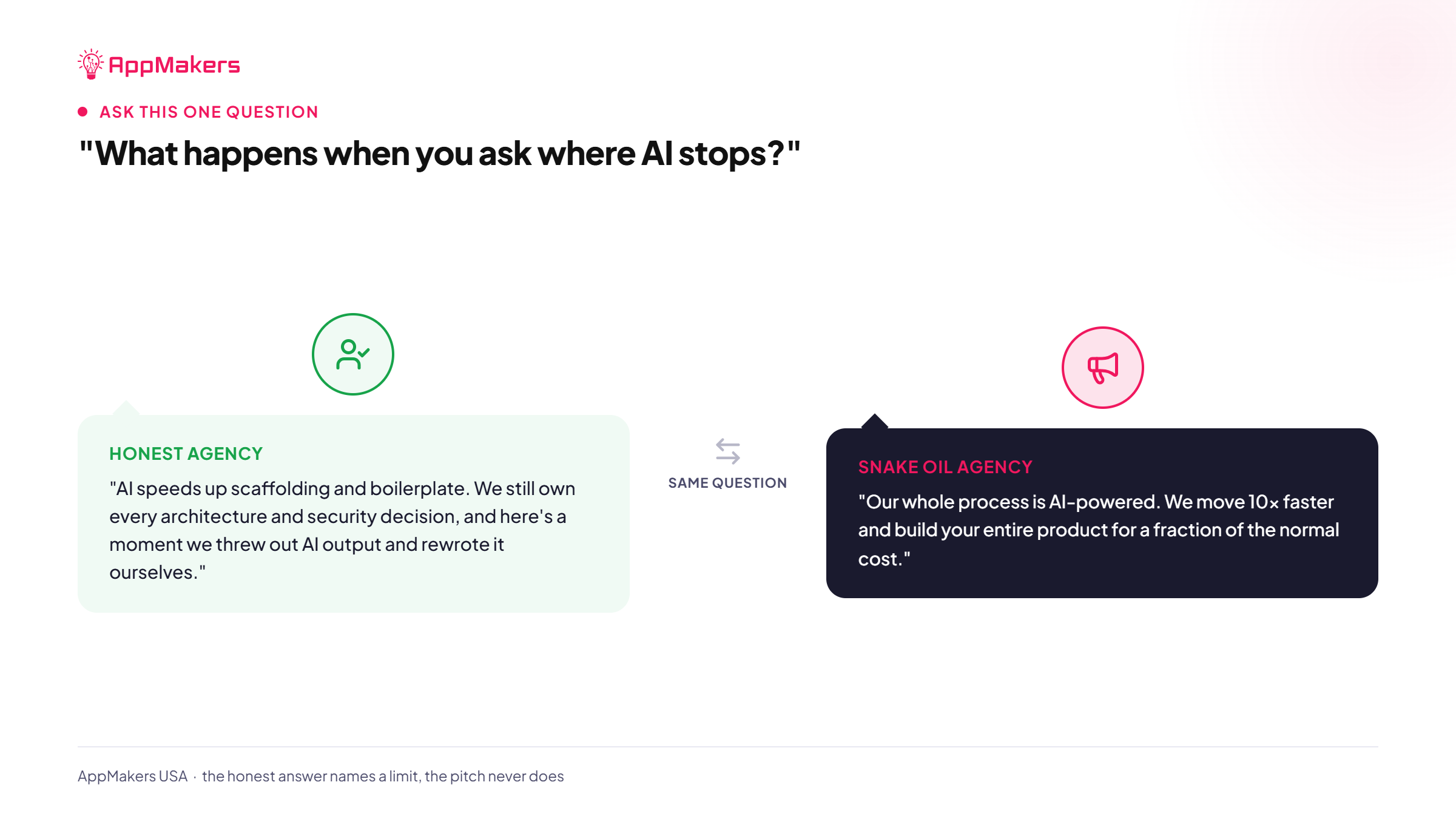
An honest agency names where AI stops, a snake oil agency does not

The reasonable position is that AI is a force multiplier, not a replacement. The difference between an agency using it right and one using it as a sales pitch usually comes down to one thing: what they say when you ask where it stops.

Green Flag: What an Honest Agency Says

  1. "AI speeds up scaffolding, boilerplate, and repetitive patterns. Our engineers still own every architecture and security decision."
  2. "We review every line of AI-written code before it ships. Here is what that process looks like."
  3. "On your specific build, AI changes the estimate in these layers and does not change it in these others."
  4. "Here is a real moment we threw out AI output and wrote it ourselves."

Red Flag: What a Snake Oil Agency Says

  1. "AI lets us build your entire product for 30% of the normal cost."
  2. "Our whole process is AI-powered."
  3. "AI handles most of it."
  4. "We move 10 times faster because of AI."

The failure mode behind the red flag is specific, and we see it arrive regularly. Someone gets a product off the ground fast, but the code underneath is a mess no one fully understands. Then they want to add a feature, hit a dead end, and there is no senior engineer who ever knew the structure well enough to extend it. The speed was real. The foundation was not.

AppMakers USA's engineers were senior before AI was a thing. The tools made them faster, not more replaceable. That distinction matters on every build, but it is especially pronounced on complex iOS and Android products where a wrong architectural call early compounds across every release that follows.

There is also a ceiling most agencies do not talk about. On a 50 to 100 engineer product, the codebase is too large for AI to drive meaningfully. You need senior engineers who understand the existing system, test it creatively, and use AI to accelerate specific tasks - not as the thing holding the architecture together.

If you are holding an AI-generated app that hits a wall, the problem is usually the foundation, not the feature you tried to add. AppMakers USA audits the codebase, tells you whether it can be extended or has to be rebuilt, and gives you a straight answer before you spend another dollar.

See if your app can be saved →

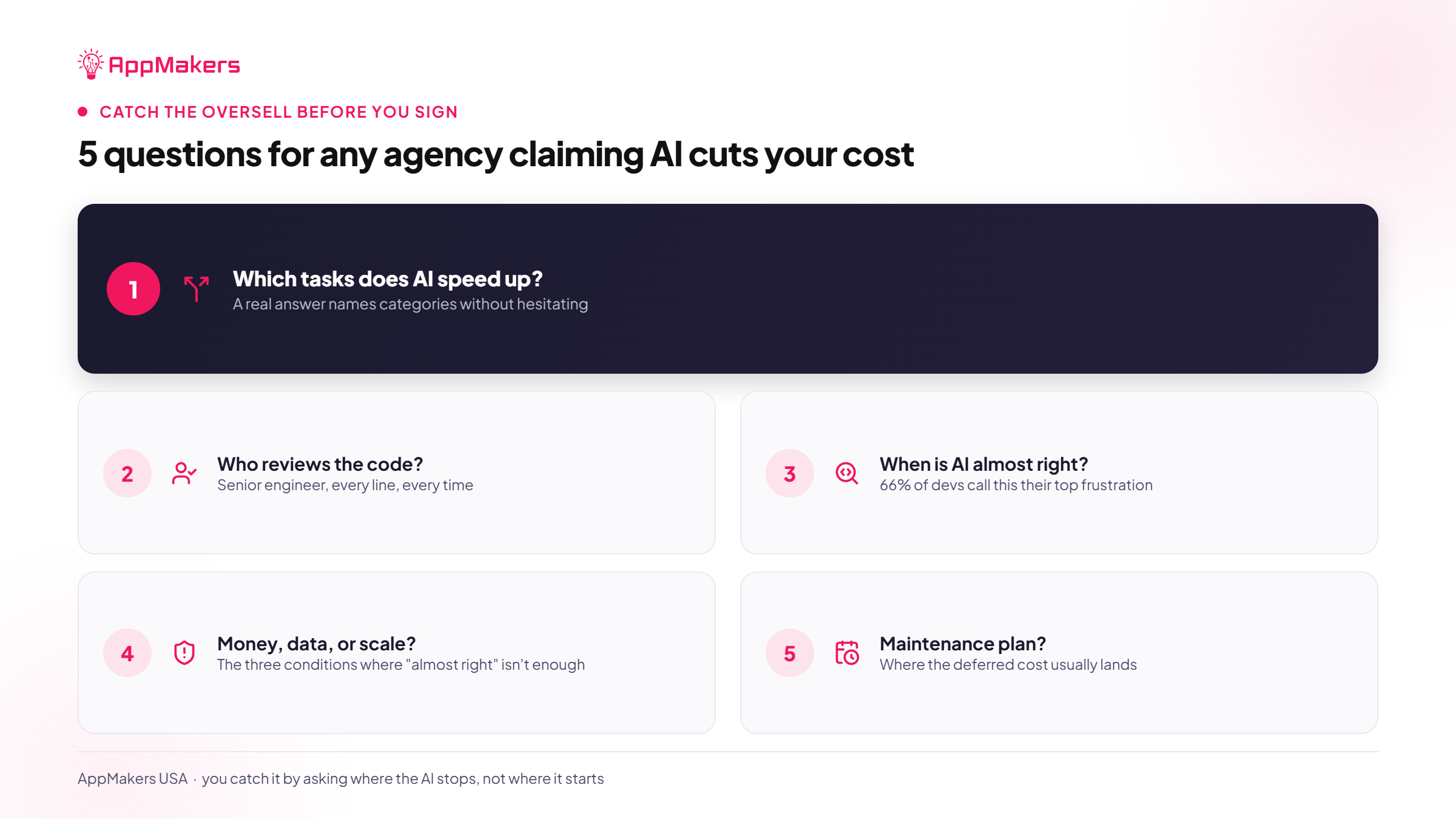
How Do You Catch an Agency Overselling AI Savings?

You catch it by asking where the AI stops, not where it starts. 

Any honest team can tell you exactly which tasks they let AI accelerate and which they keep under full human control. A team selling inflated savings gets vague the moment you push on the dangerous layers. Here is what that vagueness looks like, and what the honest version sounds like instead.

  • The Specificity of Their Answer Tells You Everything

A team that actually uses AI well names categories without hesitation: scaffolding, boilerplate, and repetitive UI patterns yes, security-critical logic and architecture decisions no. They know exactly where it earns its place and where handing it control gets expensive. A team selling snake oil says "AI handles most of it" or "our whole process is AI-powered." That is not a workflow. That is a pitch.

  • Ask Who Reviews the Code Before It Ships

The only safe answer is a senior engineer, every time, on every line that matters. We have seen what AI-generated code looks like when it ships without that review - and the problems are rarely obvious on the surface. That is why AppMakers USA caps AI involvement in production deliberately, setting file size limits and per-user constraints at the points where an unreviewed automated decision could do real damage. The guardrails are not a workaround. They are part of the process.

  • Watch for How They Handle the "Almost Right" Problem

According to Stack Overflow's 2025 Developer Survey, 66% of developers named "AI solutions that are almost right, but not quite" as their biggest frustration with the tools. A team with a real review process can describe a specific moment they caught it - a wrong assumption, a logic gap, an edge case the model missed - and explain exactly what they did instead. If they cannot tell that story, the review layer probably does not exist.

  • The Build Type Is the Clearest Filter

Money, sensitive data, and real scale are the three conditions where "almost right" stops being an acceptable outcome. If an agency is promising deep AI savings on a build that touches any of those three, that is the red flag. The cost of a wrong call in those layers is not a bug ticket. It is a breach, a drained account, or a system that fails publicly under load. Stripe's own guidance on secure payment handling makes clear how many layers of review sit between an integration and a production-ready payment flow - none of which AI can substitute for. AI does not change what those layers require. It just makes it easier to skip them.

  • The Pitch Ends at Launch. The Cost Does Not.

If an agency has nothing to say about dependency management, framework migrations, platform compliance updates, or post-launch rework, they are quoting the cheap layer and leaving the expensive one off the page. Ask what happens twelve months after launch. The answer will tell you whether they have actually thought past the invoice.

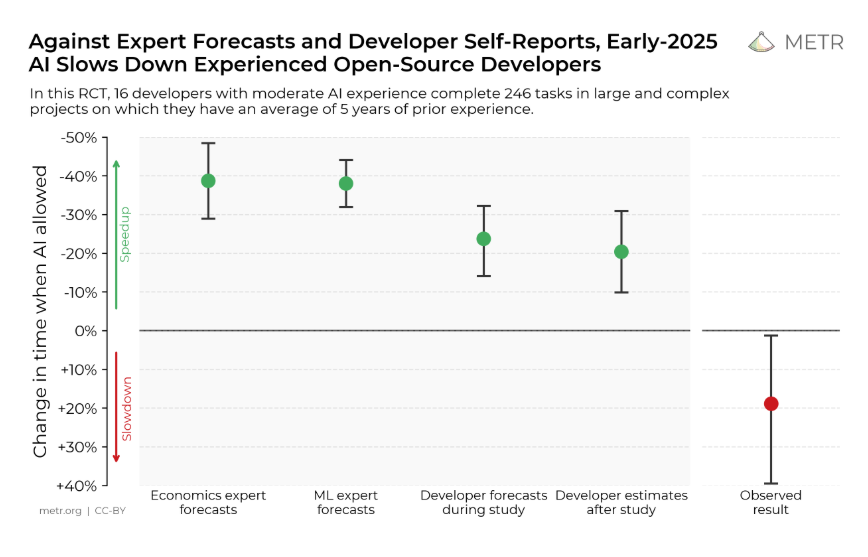
The perception problem runs deeper than most founders realize. In a 2025 METR study, experienced developers using AI tools believed they had gotten faster - but measured results showed they were actually 19% slower. If the engineers themselves cannot accurately gauge AI's impact on their own work, a founder evaluating an agency pitch has almost no chance without the right filter.

METR study: AI slowed experienced developers by about 19% despite forecasts of a speedup

Source: METR

The agencies that answer these cleanly are the ones worth handing a codebase to. The ones that dodge are selling a number, not a process.

Daniel Haiem

Daniel Haiem

Daniel Haiem has been in tech for over a decade now. He started AppMakersLA, one of the top development agencies in the US, where he’s helped hundreds of startups and companies bring their vision alive. He also serves as advisor and board member for multiple tech companies ranging from pre-seed to Series C.

Ready to Develop Your App?

Partner with App Makers LA and turn your vision into reality.
Contact us

Frequently Asked Questions (FAQ)

The clearest signal is whether your app handles money, sensitive user data, or needs to perform under real scale. If none of those three apply and the scope is focused, AI likely moves the number. If any of them apply, the expensive layers are already in play and the build cost stays close to the same.

Sometimes it shortens the discovery phase, but it rarely lowers the production cost in a meaningful way. The prototype helps validate the idea. The production build still needs the architecture, security, and integration work that AI cannot do alone - and if the prototype codebase gets carried forward, it can actually add cleanup cost before real development starts.

More than you would for a senior-reviewed build, because the early shortcuts tend to surface later as dependency updates, security patches, and platform compliance changes. A rough starting point is 20 to 30 percent of the initial build cost per year, but that number climbs if the original code was never properly reviewed.

It depends on how well the original code was reviewed and documented. AI-generated code that shipped without senior oversight is often hard to hand off because no one fully understands the structure. A new team usually needs an audit before they can extend it confidently, and in some cases the cost of that audit approaches the cost of a partial rebuild.

Yes - once the codebase reaches a certain size and complexity, the context window limits what AI can hold at once. On large products, AI still helps with isolated tasks, but it cannot drive the architecture or see across the whole system the way a senior engineer can. The return on AI tooling diminishes as the product scales, which is another reason the savings do not compound the way some agencies suggest.

See more
Chevron-1

The Honest 2026 Answer, Applied to Your Build

AI reduces app development cost in one specific situation: a focused build with no payments, no sensitive data, and no real scale, built by a senior engineer who is actually reviewing the output. Outside that situation, the savings agencies pitch are real on the layer AI touches and invisible on the layers that drive most of the bill.

That distinction is not a reason to avoid agencies that use AI. It is a reason to ask exactly where they use it, who reviews it, and what their number looks like on your specific build - not on the category of app in their pitch deck.

The founders who get that answer early make better decisions. The ones who find out later pay for the gap.

Get a straight answer on what your app should cost and where AI genuinely helps. AppMakers USA will scope your build layer by layer, show you where AI actually moves the number, and flag any place a competitor's savings claim does not hold up. No padded estimate, no inflated discount.

Talk to Our Team Today →


Exploring Our App Development Services?

Share Your Project Details!

Vector-60
We respond promptly, typically within 30 minutes!
Tick-4
  We’ll hop on a call and hear out your idea, protected by our NDA.
Tick-4
  We’ll provide a free quote + our thoughts on the best approach for you.
Tick-4
  Even if we don’t work together, feel free to consider us a free technical
  resource to bounce your thoughts/questions off of.
Alternatively, contact us via phone +1 310 388 6435 or email [email protected].

    Copyright © 2026 AppMakers. All Rights Reserved
    Follow us on socials:
    linkedin facebook pinterest youtube rss twitter instagram facebook-blank rss-blank linkedin-blank pinterest youtube twitter instagram