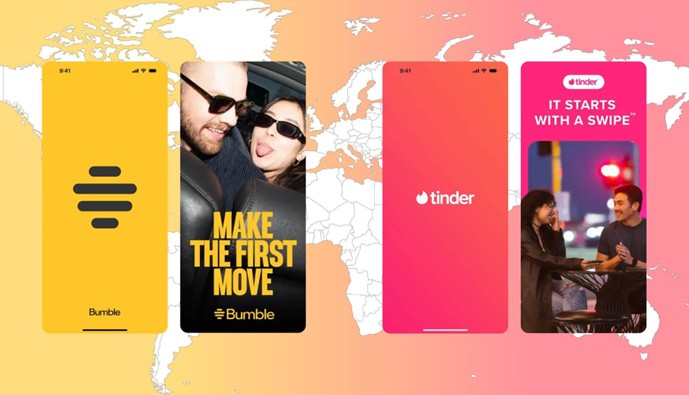
Bumble vs. Tinder: two apps that dominate online dating, built on the same swipe-and-match core, with almost nothing else in common once you look at how each one is actually engineered.
Bumble puts women in control. Tinder casts a wider net. But how do their matchmaking algorithms, retention strategies, and revenue models actually compare? And what can app developers learn from the choices each one made?
Let's break down how Bumble and Tinder compare from an app maker's perspective, so you can see not just how they work, but why they were built that way.
When creating a dating app or developing a digital strategy, understanding user demographics and market reach is crucial.
Bumble primarily targets professionals aged 25-35 who are interested in meaningful relationships, with a large portion, 72% under 35, according to multiple independent trackers. It has also broadened its scope beyond dating by introducing Bumble BFF and Bumble Bizz.
In contrast, Tinder appeals to a younger audience, particularly 18-24-year-olds and college students, who are often looking for casual dating experiences.
In terms of gender representation, Bumble's "women message first" design doesn't come with a heavily male-skewed user base the way you might assume. Current tracking puts it close to balanced, roughly 54% male to 46% female, with some sources showing it even further toward female. Tinder's user base, by contrast, is genuinely predominantly male, somewhere in the 75-76% range depending on the source.
Regionally, Bumble and Tinder are closer competitors than the "Tinder dominates" narrative suggests. Recent US market-share tracking puts Tinder around 25-29% and Bumble close behind at 24-26%, with Hinge, also owned by Match Group, at roughly 18% and growing fast enough to be cannibalizing Tinder's own numbers from inside the same parent company.
Worth being direct about here: Match Group doesn't publicly disclose Tinder's total monthly active user count. The "75 million" figure gets repeated across the internet, but per Match Group's own SEC filings, the only audited number is paying subscribers, around 8.6 to 8.9 million as of Q1 2026, down from a 2022 peak near 10.9 million. Both Tinder and Bumble saw revenue and paying-user declines through 2025 into 2026, while Hinge grew. If you're benchmarking against these apps for a new product, that competitive shift matters more than either app's raw user count.
Swiping mechanics and matchmaking algorithms are where Bumble and Tinder diverge most clearly.
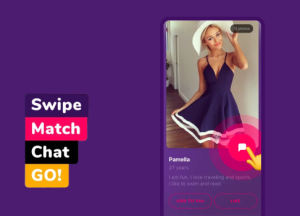
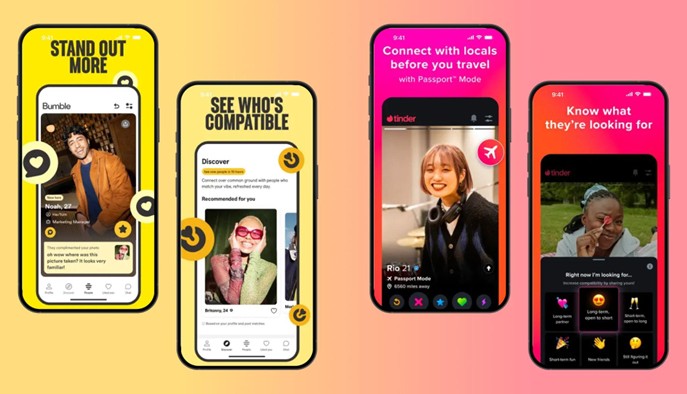
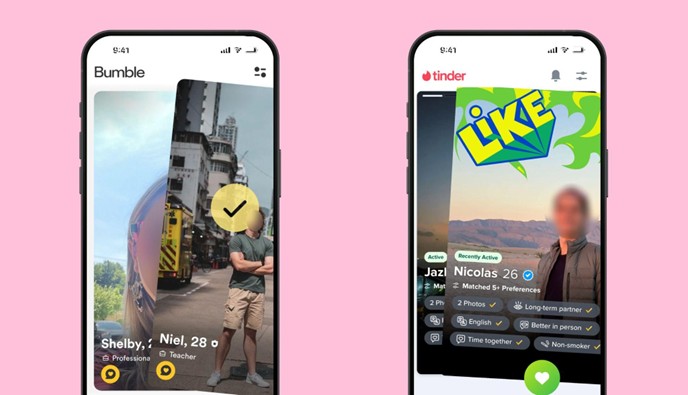
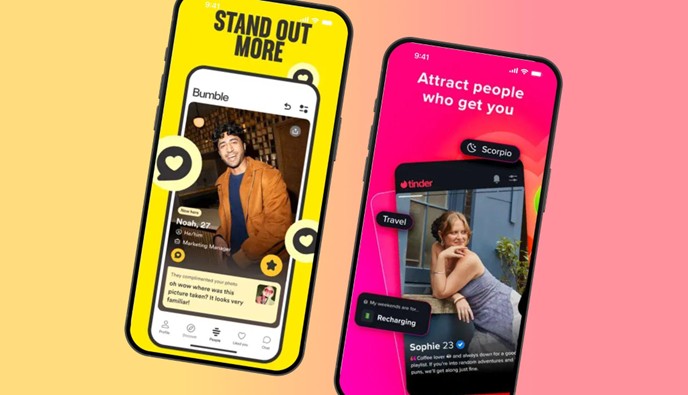
Both apps use the standard right swipe for interest, left swipe for rejection model. Tinder adds an upward swipe for "Super Likes," a gesture that can lead to accidental matches when it sits that close to the other two. Bumble's swipes are more deliberate, with a cleaner, minimalistic design that reduces those errors. Bumble further enhances usability by allowing users to rearrange profile photos through a convenient drag-and-drop feature.
Despite the differences, both apps are designed to encourage fast interactions from the start.
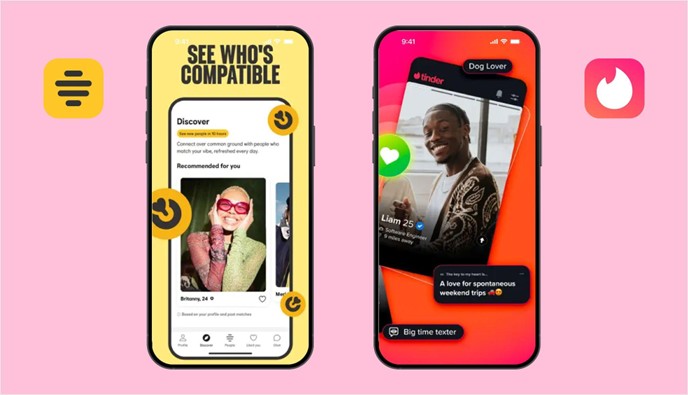
When it comes to matchmaking, Tinder's algorithm prioritizes user activity, location, and profile popularity, favoring high-engagement users. Bumble, however, takes a more AI-driven approach, analyzing swiping behavior, past matches, and shared interests to refine compatibility.
Bumble also rewards respectful engagement and offers advanced filtering and personalized prompts, improving match quality. Additionally, its cross-platform integration with apps like Instagram helps users showcase more of their personality, which shows up in better engagement and retention.
Tinder, by contrast, leans more on profile visibility and engagement metrics rather than deep compatibility analysis, making it more about volume over precision in matching.
At their core, Tinder and Bumble operate on the same swiping logic. Their feature sets tell a different story.
How much does personality matter in a first impression? That depends on the app.
More structured profiles may increase quality matches, but Tinder's photo-first approach leads to higher swipe volume.
When you're building a dating app, you should aim for a balance of swipe-based interaction and structured user engagement, or risk losing users after the match. AppMakers USA can help you identify the right mix of features for your market.
While Tinder is laser-focused on dating, Bumble takes a slightly broader approach and offers opportunities to build friendships and professional connections, too.
That expansion pays off directly: Bumble Bizz and Bumble BFF give Bumble a second and third revenue stream outside pure dating, membership fees and sponsored content in each mode, while Tinder keeps its build simpler by staying in one lane.
With online safety concerns on the rise, dating apps must do more to protect users from potential scams and harassment. Bumble has positioned itself as a leader in this space, while Tinder relies more on user moderation.
Online safety has become a real selling point in dating app design heading into 2026, and apps with strong verification measures tend to attract more security-conscious users and hold onto them longer.
Swiping mechanics and algorithms lay the foundation for initial matches. How a conversation begins is what drives meaningful connections, or causes users to lose interest.
On Bumble, you're prompted to start chatting within 24 hours, creating urgency but sometimes resulting in missed connections if messages go unanswered. The app encourages thoughtful openers with structured prompts like Netflix recommendations or the "Two truths and a lie" game, which its own product team has cited as improving response rates.
Bumble's model uniquely positions itself as a feminist dating app, attracting confident women who prefer initiating conversations. Bumble also ensures a safer environment by offering verified accounts to reduce fake profiles and enhance user trust.
In contrast, Tinder allows users to message instantly after matching, leading to spontaneous interactions that can often feel superficial due to overwhelming message volume. Tinder's approach is volume-driven, which may appeal to users seeking quick, casual interactions.
Ultimately, Bumble's model favors intentional engagement with creative icebreakers, while Tinder's instant messaging promotes rapid exchanges that are better suited to those looking for something more casual.
Understanding these dynamics can help developers optimize user experience and engagement, and AppMakers USA builds customized solutions that align with your app's goals.
Gender norms shape how users interact on dating apps, whether that's who makes the first move or how power dynamics play out post-match.
Bumble's "women-first" approach challenges traditional norms, allowing women to initiate conversations. However, societal pressures remain, which can lead to feelings of empowerment along with anxiety about being perceived as overly assertive.
Many women appreciate the ability to choose when to initiate conversations. But while Bumble markets this as a feminist approach, it actually outsources the responsibility of equality to individual users rather than addressing deeper systemic issues.
Tinder takes a more open-ended approach, allowing either party to message, but in practice, men often initiate. This reinforces conventional gender roles, keeping the platform aligned with familiar dating norms rather than challenging them.
That setup results in higher engagement for Tinder overall, but it also means women receive significantly more messages, which can affect satisfaction and retention on their end.
Although Bumble has expanded gender options to include non-binary identities, both platforms generally cater to cis-heteronormative users, which limits inclusivity. More inclusive UX design, better matchmaking for LGBTQ+ users and customizable gender preferences, could expand audience reach and retention for either platform.
Bumble provides users with a greater sense of security by reducing occurrences of unsolicited images and messages.
Ultimately, even though Bumble aims to reduce harassment by empowering women to initiate interactions, traditional dynamics and expectations regarding femininity and masculinity still persist after matches are made.
Designing for gender dynamics is about creating a user experience that balances engagement, inclusivity, and safety, and both apps show how user behavior ends up shaping a platform's culture over time.
AppMakers USA has built dating apps before, including Krush, a curated, referral-based dating community, and that experience carries over directly to decisions like these: adapting to evolving user expectations, whether that means redefining gender roles or improving user safety.

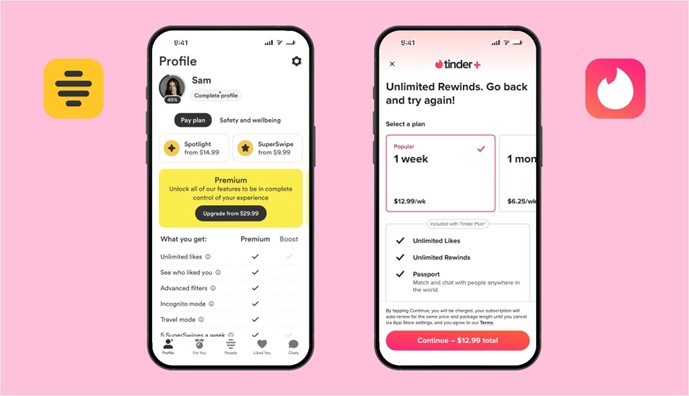
Bumble and Tinder both run freemium models: basic features are free, premium perks cost money. How they monetize from there is where the real differences show up.
Both apps have tiered subscription models, but their strategies cater to different user behaviors. And while Tinder monetizes urgency and volume, Bumble leans into control and exclusivity.
Tinder offers Tinder Plus, Gold, and Platinum plans:
Bumble’s Boost and Premium plans focus on enhancing engagement:
Beyond subscriptions, both apps bank on one-time purchases that boost visibility and engagement.
With Tinder's Boost and Super Likes, users pay to increase profile visibility and make their likes stand out. Bumble Spotlight and SuperSwipes work the same way, though Bumble markets it as a more intentional way to connect rather than raw visibility. Both are betting on the same thing: people will pay to be seen.
Both apps also monetize through ads, but, again, their approaches differ.
Both apps also integrate event-based monetization, such as pay-to-attend virtual speed dating events or exclusive features tied to special occasions.
If you're building a dating website, the lesson from both apps is the same: people pay for convenience, exclusivity, and exposure, in that rough order of what moves the needle most. Get the revenue streams right and you can grow engagement and profitability at the same time, without pushing your existing users away.
Your experience on a dating app depends heavily on where you're swiping, not just how. User behavior, app dominance, and engagement levels all shift depending on the region.
In the U.S. and Canada, Tinder dominates casual dating, using its large user base which increases the number of potential matches simply through scale. Bumble tends to attract relationship-focused users in the 25-35 age group specifically, where its "women-message-first" model gets more traction.
In Europe, the landscape changes:
Tinder remains popular in the UK and Germany, but the competition heats up elsewhere. Apps like Badoo, Lovoo, Happn, and Meetic often surpass Bumble in user engagement. Notably, Badoo surpasses Bumble in overall popularity in countries such as France, Spain, and Italy.
Across Latin America and the Asia-Pacific regions, Tinder continues to be the preferred option, showing its adaptability in over 190 countries.
Bumble struggles more in non-English-speaking markets, which limits its global reach. It has gained some international traction by leaning on photo verification processes as a safety differentiator, though that hasn't closed the gap with Tinder's scale.
Regional trends dictate which features succeed and which fail, which is exactly why a one-size product rarely works across every market at once. AppMakers USA builds customized development solutions with that constraint in mind from the start.
For stronger privacy and security, look for apps with robust end-to-end encryption, clear data retention policies, photo verification, and user-controlled data settings. Bumble and Tinder both offer safety features, but Bumble emphasizes proactive moderation, while Tinder focuses on user-reporting tools.
You may be able to recover a deleted account, typically within 30 days, by logging in or contacting support and verifying your identity when requested. After that period, your data is permanently erased and cannot be restored.
Both apps offer photo verification, where users upload a selfie matching a pose. Bumble also requires verification in certain cases, like if a profile is flagged. Neither app mandates full ID verification, but both encourage it for added trust.
Both apps will hide inactive profiles over time, reducing their visibility in swiping queues. However, Tinder’s algorithm prioritizes active users, while Bumble tries to encourage re-engagement by sending notifications and prompts.
Bumble includes distinct modes for friendships and professional networking—Bumble BFF and Bumble Bizz—allowing users to expand their connections beyond romantic interests. It also hosts career-focused events and utilizes AI to provide personalized matches aimed at creating meaningful connections outside of traditional dating. Tinder remains a dating-focused app but still offers interest-based discovery through its Explore tab.
The dating apps that hold up long-term are the ones built for one kind of user, not every kind of user. Bumble bet on intentional, structured interaction. Tinder bet on speed and volume. Both bets worked, for a while, though 2025 and 2026 have been rougher on both companies than the narrative usually admits: revenue and paying users down at both, while Hinge (also Match Group) picked up the growth neither of them could hold onto.
That's the real lesson for founders: know which trade-off you're making, and build for it deliberately instead of trying to serve every user type at once.
Looking to create a dating app with a clear point of view? AppMakers USA builds custom solutions that optimize user experience, engagement, and retention. Let's chat about your ideas.