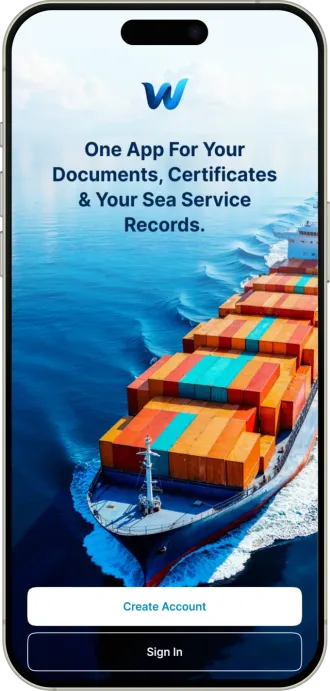
Wave holds a seafarer's certificates and sea service record. We built it local-first, because the people who need it are usually at sea.
Two separate stacks of documents decide whether someone can keep working at sea, and both of them are fragile.
Licensing, regulatory and statutory documents, industry-required training, travel papers. Each one carries an issuing authority, a certificate number and an expiry date. Let one lapse and the next contract is at risk, because the paperwork has to be produced on demand, often in a foreign port.
Time at sea is the currency of a maritime career. Sitting for the next certificate of competency means proving the days: which vessel, which flag, which rank, from when to when. That record is usually scattered across old contracts, discharge books and memory.
Wave's job is to hold both stacks, keep them current, and hand them over in a usable format when an employer, a crewing agency or an inspector asks. The complication is where that request tends to happen.
Every certificate is stored under its category with its issuing authority, number, issue date and expiry date, and the scanned document itself attached to the record. A multi-page scanner is built into the app, so a paper certificate becomes a filed PDF without leaving Wave or finding an office scanner. Renewal reminders run off the expiry dates already in the record.
Each record holds the vessel, its flag, the rank served and the date range, and the app computes the duration. The full history filters by date, vessel type, vessel name, rank and flag. That is what turns a pile of old contracts into an answer when a crewing agency asks how much tanker time someone has as an officer.
Once the service history is complete, the sum becomes useful on its own. A user sets a target rank and vessel type, and Wave measures the logged sea time against what that step requires, then shows the gap that is left.
It reframes a filing chore as visible progress towards a promotion, which is the reason anyone keeps the records current in the first place. The whole record exports as a PDF when an employer or a maritime authority asks for it.
Most apps treat loss of connectivity as a failure state to survive. Wave's users spend weeks at a time somewhere a connection is expensive, shared, satellite-backed or simply absent. The requirement was not that the app degrade politely. It was that the app stay fully usable with no connection at all, and then agree with the server later.
We built the data layer on PowerSync. Writes land in the local database on the device immediately and reconcile with the backend afterwards. The user is never waiting on a request to know whether their own action worked.
The useful part was a side effect we did not set out to buy. Because every interaction reads and writes locally first, the interface feels instant regardless of what the network is doing. Combined with Flutter's render performance, backend latency stopped being something we tuned for at all. The architecture is optimistic by default, so a round trip to the database never sits between a tap and what the user sees.
We had been evaluating Flutter for a while and this is the project where we committed to it. Runtime performance was the reason on paper, and it delivered.
We dropped Express for Hono on the backend specifically because Wave deploys on Cloud Run. Hono has a lighter footprint, which means faster cold starts and lower memory per instance.
Development began well after an R&D phase that had never been finished. By the time the build started, the shared understanding of scope, priorities and even some core product assumptions had decayed. A real share of early development went into re-aligning the team and the stakeholders on what was actually being built, and into revisiting decisions that had never been validated in the first place.
None of that appears as a risk on a spec sheet. It appears as rework.
We now treat a long pause between discovery and build as a scheduling risk of its own, not as dead time. When a project restarts after a gap, the first work item is re-validating the assumptions the original research produced, written down, before anyone estimates a sprint. Product memory decays faster than most teams expect, and rebuilding it in the middle of a build is the most expensive place to do it.
Wave shipped to the App Store and Google Play in July 2026 and is available on iPhone and iPad.
The September 2026 release deepened offline handling: add documents with no connection, open them instantly, see exactly what is stored on the device.
Users choose whether document downloads run on Wi-Fi or mobile data, because at sea the connection is a budget as well as a signal.
The clearest signal that a foundation was right is what the team does next with it. On Wave, the offline layer has not needed rescuing. It has been built on: more of the document workflow moved onto the local-first path after launch, and the user gained explicit control over what syncs and when. That is a roadmap running forward, not a system being patched.
Offline-capable apps, sync architecture and the awkward domain rules that come with regulated work. Tell us the constraint and we will tell you what it costs to build around it.
Los Angeles based. We build for iOS, Android and the web.