Dating app monetization without the backlash starts when you stop charging people for hope.
Users will pay to save time, feel safer, or get better matches. They won’t pay to escape the friction you created. Your job is to keep the free experience genuinely usable, then offer upgrades that make the experience smoother and more predictable, with rules users can understand in ten seconds.
If a paid feature claims it improves outcomes, you need to measure it and be ready to roll it back when it doesn’t. If it mainly drives urgency, it will show up fast in reviews, refunds, and churn. The good news is that “fair” monetization is not complicated. It’s clarity, control, and proof.
The rest of this guide shows how to design that system without losing user trust.

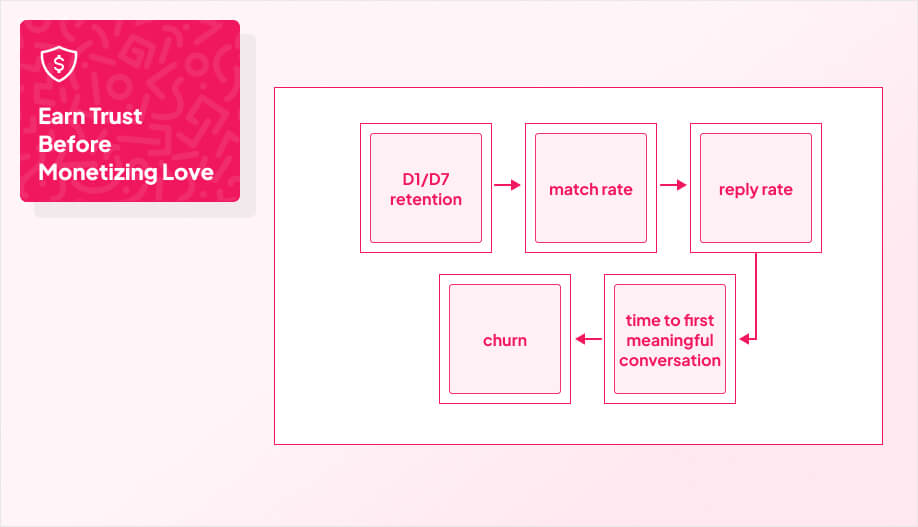
Before you price anything, make sure users actually win on your app. If people are not getting quality matches and conversations, monetization will feel like a tax, and they will bounce the second they hit a paywall.
The market is big enough that there’s real money on the table, but the winners still live or die on trust and momentum. Match Group reported $3.5B in total revenue for 2024, and Bumble reported $1.07B for 2024.
Those businesses work because their core loop keeps users moving forward.
So define “progress” with metrics you can track weekly:
Once those are stable, monetization becomes easier because upgrades feel optional, not necessary.
This is also why tiered subscriptions and add-ons work when the base experience is strong. Tinder’s own tiering shows the pattern of free core, then layers of convenience and visibility.
Use personalization to raise the emotional ROI per session, but do it responsibly. Better matching and smarter ranking reduce “wasted” swipes, which makes users more open to paid efficiency later. And do not treat security and scalability as a later problem. If the app feels unsafe, or it breaks under load, revenue will not save it.
Finally, instrument everything and segment honestly. Cohort, acquisition source, and user intent will change both LTV and how “fair” pricing feels. At AppMakers USA, we typically won’t recommend pricing changes until the progress metrics above are moving in the right direction for the cohorts you actually want to keep.

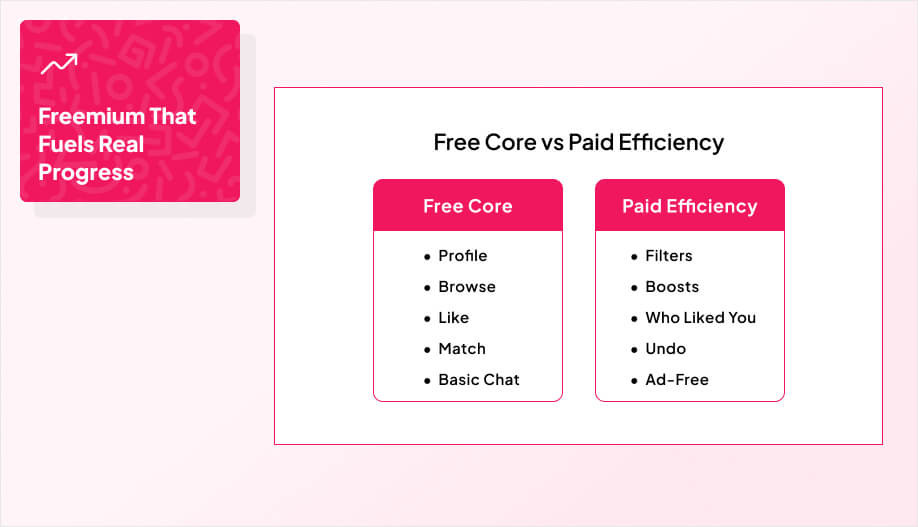
If your core experience already delivers real progress, freemium becomes the cleanest way to monetize without turning users against you.
Freemium works in dating when the free tier stays genuinely usable and the paid tier sells efficiency. Keep profile creation, browsing, liking, and matching free. Then monetize time savings and momentum and this includes advanced filters, boosts, and “who liked you.” This approach is critical in a market with over 300M active users, where they help people get to better conversations faster, not when they block the basics.
Here’s how the emotional experience should map to the monetization layer:
| What the user should feel | What causes it in the product | What you monetize without backlash |
|---|---|---|
| Relief when free users match | Matching and basic chat work without paywalls | Optional upgrades that speed up discovery, not unlock it |
| Urgency when boosts move you to the top | Time-limited visibility that’s clearly labeled | Boosts, spotlight placements, short-term bundles |
| Control with filters that save hours | Filters reduce noise and surface better fits | Advanced filters, preference-based discovery tools |
| Fairness because access stays open | The core loop stays usable for everyone | Subscriptions that add convenience, not basic access |
Treat conversion as a health signal, not the goal. Most teams aim for single-digit free-to-paid conversion, but retention and match quality matter more than squeezing the funnel. For non-payers, ads can work if they’re controlled and relevant, and an ad-free upgrade should be simple. Add microtransactions like coins, boosts, and bundles to capture intent spikes without gating core chat once a match happens.
As you layer monetization, match it with transparency like clear privacy safeguards, age guidance, and plain-language explanations of what paid features do.
This is exactly what we help teams implement at AppMakers USA when we are building or rebuilding a dating product. This serves as a freemium foundation that keeps the core experience open, then layers in paid efficiency in a way users accept.

Freemium gives you reach. Subscriptions give you predictability, but only if the tier feels like a fair upgrade, not a toll.
Users accept dating app subscriptions when the value is obvious and consistent like fewer dead ends, more control, and faster progress. Tiers also feel “normal” now because most major apps use them, so the concept does not surprise users. What triggers backlash is when a subscription blocks basic connection, or when perks feel like pay-to-win.
The category is big enough that subscriptions are still a proven bet. Global dating app revenue exceeded $6B in 2024, with North America driving about 50% of that revenue. That’s why a lot of pricing tests start there, then get localized.
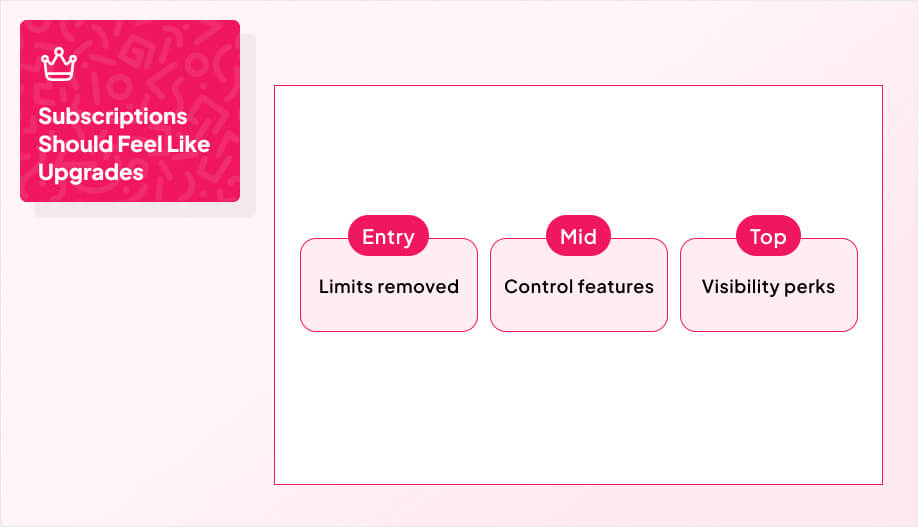
A tier structure users tend to accept
| Tier goal | What to include | What not to do |
|---|---|---|
| Entry tier | Remove one painful limit and add one clear perk | Don’t lock core messaging behind pay |
| Mid tier | More control: stronger filters, visibility tools, better sorting | Don’t bury perks in fine print |
| Top tier | Power users: priority signals, advanced discovery, higher limits | Don’t make it feel like the only way to succeed |
To reduce microtransaction fatigue, bundle the most-used perks into the membership and keep one-off purchases truly optional. Trials can work too, as long as the downgrade path is clear and not designed to trick people.

Subscription tiers set expectations. The backlash usually starts with what you gate, and how it feels in the moment.
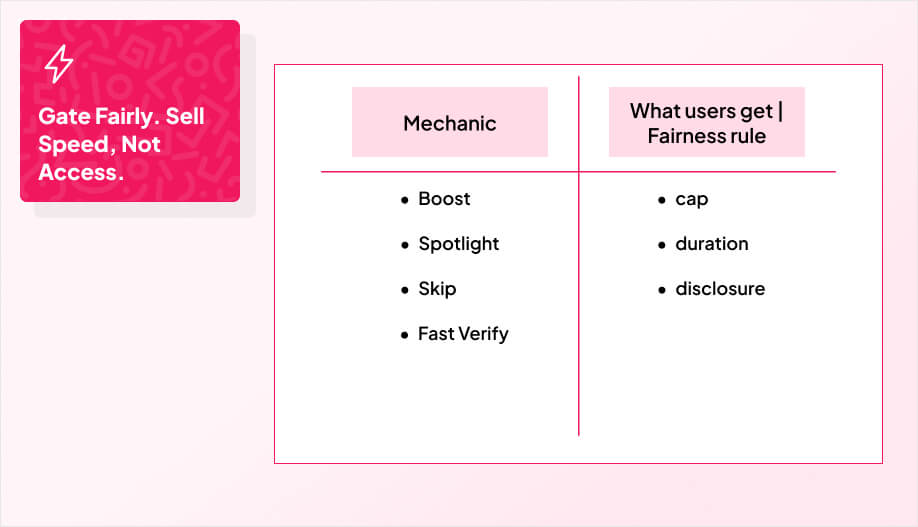
Fair gating wins because it sells efficiency, not access. Keep browsing, matching, and basic chat usable for everyone. Then charge for speed and visibility in ways users can understand: boosts, spotlights, skips, faster verification, or early exposure that fades back into the normal feed.
This is also where implementation matters more than ideas. AppMakers USA help teams design the gating rules and upgrade UX so it feels clean and predictable, not pay-to-win.
There’s real demand for this when it’s done cleanly. In May 2025, estimated consumer spending across Tinder, Bumble, and Hinge hit $340M for the month. That scale only holds when users feel like they’re buying a moment of momentum, not paying a ransom to participate.
Boosts work best with guardrails:
What users should feel:
Pairing these mechanics with responsive design and performance optimization ensures a smooth experience across devices, further boosting engagement and retention.

Boosts and gating are where users feel the friction. Pricing is where they decide whether you’re fair.
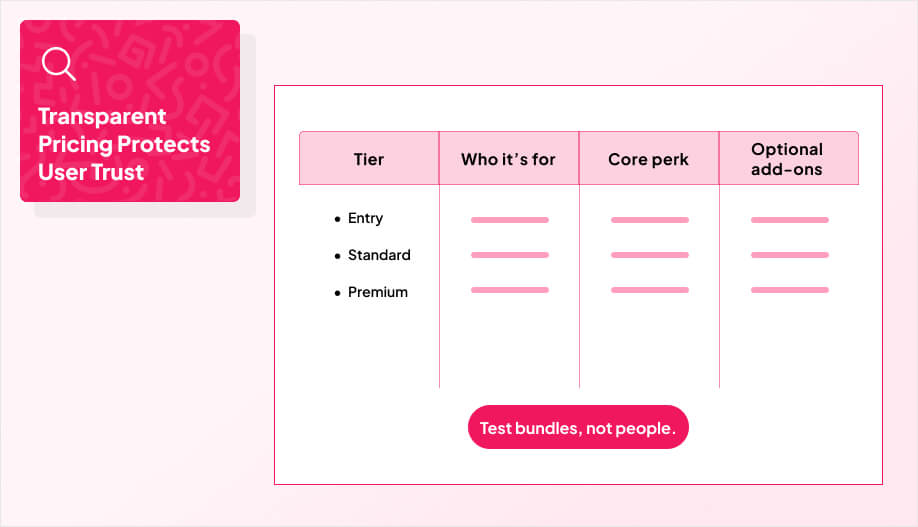
If you want revenue without eroding trust, price by clear tiers and clear rules, not by a black-box system that quietly changes what people pay. Research by Mozilla and Consumers International found that older users were often charged more. And personalized pricing can turn into a PR problem fast, especially if users feel penalized for age, location, or desperation.
Start with a published price matrix. Keep it simple enough that support can explain it in one message, and the product can defend it in one sentence. If you need segmentation, do it openly like regional pricing, student pricing, limited-time promos, or new-user trials. Avoid per-user quotes.
This is also where we see teams lose months by testing the wrong thing. So, we (AppMakers USA) structure experiments around tier value, bundles, and paywall timing so you can learn without creating a fairness blowback.
What to test
What to track
If your pricing feels predictable and your tests are clean, you can push revenue without training users to distrust the app.

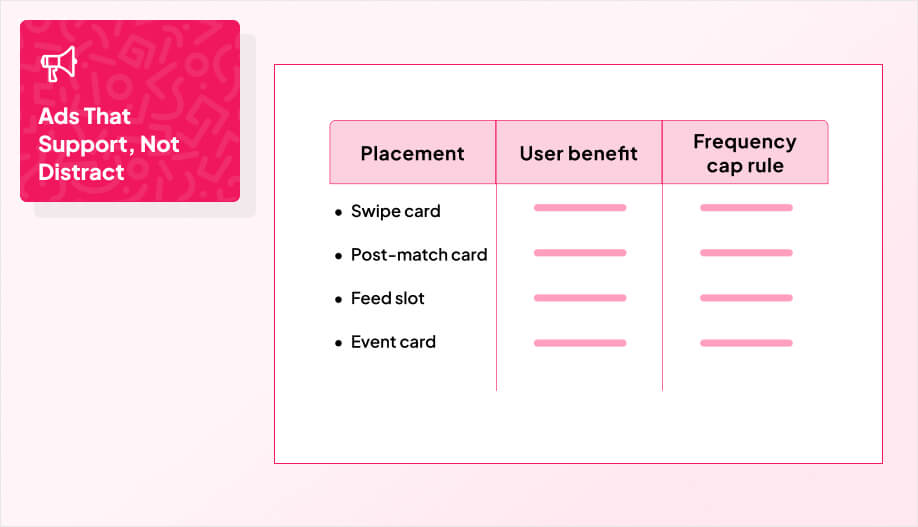
Once your pricing is transparent and your experiments are clean, ads and partnerships become your “keep the free tier fair” lever. But only if they help the user. If they feel like noise, they will tank sessions and trust faster than a bad paywall.
The safe rule: no pop-ups, no takeovers, no random banners.
Keep ads native to the motions users already accept. Think swipeable cards, a single promoted slot in a feed, or a “first date idea” card after two people match. Partnerships with different niche dating apps work best when they reduce friction. And this means features like reservations, venue perks, event access, rides, even simple discounts that make planning easier.
Make it contextual and local. A sober dating app should not run the same partners as a nightlife-heavy one. City offers and community events can feel like part of the product when they match the audience and timing.
Set guardrails so it never becomes spam:
Good partnerships do one thing well: they turn “chatting” into “we actually met,” without turning the app into a coupon book.

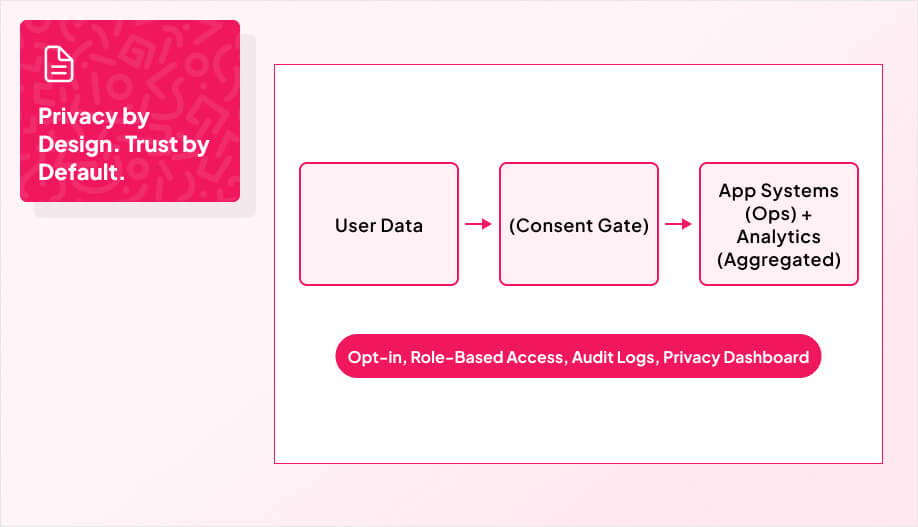
A privacy-first approach is simple: collect only what matching and safety truly need, and put anything else behind a clear opt-in that users can understand in one glance. If the user would feel surprised reading it in a headline, don’t do it.
Here’s the safer pattern that still gives you useful insight:
Behind the scenes, your internal tooling and review workflows should rely on structured prompt templates so any AI assistance with sensitive user data remains consistent, auditable, and constrained.
At AppMakers USA, this is usually where we push teams to write the policy in plain language first, then build the data pipelines and permissions to match it. Our team of 30 US developers builds and maintains cross-platform systems with strong security and privacy controls tailored to complex data-monetization models.
We believe that if you can’t explain it clearly, the product shouldn’t be collecting it.
Make refunds predictable: one clear window, one clear rule, and fast support. Then fix the top two triggers (confusing renewals, unclear boost impact). If people feel tricked, they dispute. If they feel heard, they churn quietly or they stay.
Put limits on visibility advantages. Cap boosts per day, rotate exposure, and protect new or high-quality profiles from being buried. If non-payers stop getting matches, you did not build monetization. You built a churn machine.
Weekly plans can work for high-intent spikes, but they also attract regret if value is not immediate. Lifetime plans work only when the app has long-term utility beyond “I found someone.” If you offer lifetime, tie it to durable benefits, not temporary visibility.
Use regional pricing openly and keep tiers consistent. Do not silently change prices per person. If users can screenshot two different prices for the same tier in the same country, you are asking for backlash.
Watch for a pattern, not a single metric: rising refund rate, more one-star reviews mentioning “scam” or “paywall,” drop-offs right after first match, and support tickets about boosts not working. When trust dips, engagement drops next, then revenue follows it down.
Dating app monetization without the backlash comes down to one choice: monetize progress, not access.
Keep the core loop usable, sell efficiency in clear tiers, and use boosts and time-based upgrades with honest rules and visible limits. Price with transparency, test bundles instead of people, and treat privacy and safety as part of the product, not legal text at the bottom of the page. When users feel in control and can still succeed without paying, upgrades stop feeling like a toll and start feeling like a shortcut.
If you want help tuning your model, AppMakers USA can audit your monetization flow, identify the friction points that trigger churn, and redesign tiers, gating, and experiments so revenue grows without hurting trust.