Home
Our Process
Portfolio
FAQ
Where can I see your previous work?
Check out our portfolio at AppMakersLA.com/portfolio
What services do you offer?
We are a Los Angeles app and web development company. As such, we offer: 1) Design for Apps, Webapps and Websites 2) Mobile App Development for iPhone Apps, Android Apps and iPad Apps & Web Development for Webapps. Each project includes full QA Services as well as a product manager.
Where are your app developers located?

Our app developers are mainly located at 1250 S Los Angeles St, Los Angeles, CA 90015, though we have other offices around the world, and we hire the best developers wherever and whenever we find them. If having engineers & designers in Los Angeles is critical to the project, we have the resources to make that happen.

How much do you charge for your services?
Our cost varies depending on the project. Please contact us for a mobile app development consulting session and we will get you an estimate + analysis pronto.
Can you build software for startups?
Yes, we consider ourselves a startup app development company, as well as an agency that builds software for already established firms.

Discover 30+ more FAQs
View all FAQs
Blog
Contact ussms IconCall Icon
We answer our phones!
Popular Apps / A Look at...

A Look at Venmo’s Key Statistics and How It Generates Income

Even if you landed here searching for “venmo statistics and generate income”, it is easy to think of Venmo as just another payment app

In reality, it is woven into rent splits, side gig payouts, and small merchant checkouts in a way that quietly adds up to real revenue. You tap a few buttons to pay a friend; behind that transfer are fees, partnerships, and product choices that make real money for PayPal. 

Once you see the numbers behind its roughly 90 million users and the volume they move, Venmo turns into a case study in how a simple consumer app can turn everyday habits into a business.

Inside Venmo’s Volume Curve and Everyday User Behavior

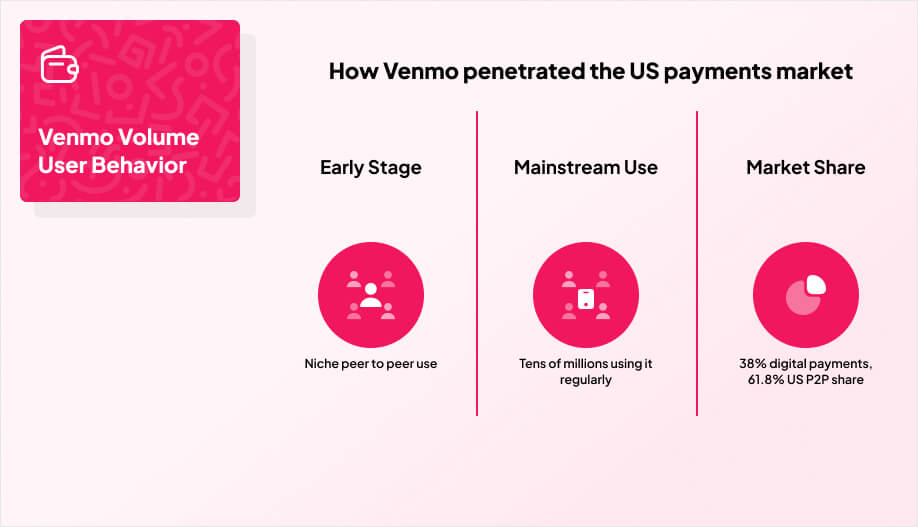
a simple 3-column comparison graphic that shows how Venmo penetrated the US payments market

Over the past decade, Venmo has gone from a niche peer-to-peer tool to one of the dominant ways money moves between friends, roommates, and side gigs. What started as a social layer on top of payments is now a core habit for a big chunk of US consumers, reinforcing its reported 38% market share in the digital payment space.

You can see the shift in how people use it. Early years were about basic adoption. Now the story is repeated use, more active accounts, and a steady climb in transaction volume rather than one time sign ups. User counts jumped from around 10 million in 2017 to 52 million in 2020 and roughly 80 million by 2022. By early 2025, Venmo was processing more than over $300 billion annually, underscoring how quickly its transaction volume continues to scale.

Today, Venmo is estimated at 61.8% of US peer to peer payments, which gives it real leverage with merchants and partners. Demographic data shows that about 68% of users are Gen Z or Millennials and a large share live in higher income households. 

That is exactly the kind of engaged audience you design for when you build payment enabled experiences with a partner like AppMakers USA.

From Daily Micro-Transactions To Billions In Annual Volume

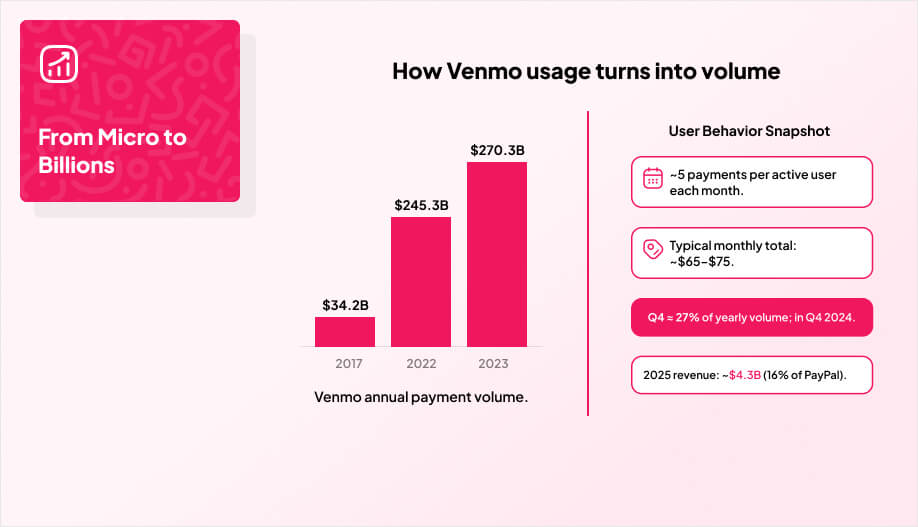
a split graphic with simple bar chart and behavior snapshot that shows how Venmo usage turns into volume

Since Venmo’s user base has scaled into the tens of millions, the more telling story is what those users actually do on the platform: how often they pay, how much they move, and when activity spikes. With an estimated 85.1 million users in 2023, Venmo has become one of the most widely adopted consumer payment apps in the US.

You are looking at a service that pushed about 270.3 billion dollars in 2023 volume, up from 245.3 billion in 2022 and just 34.2 billion in 2017. Annual payment volume grew another 17% in 2024, which shows how quickly it is becoming part of everyday consumer payments. Q4 alone often delivers around 27% of yearly payments, with 75.6 billion dollars in Q4 2024 as holiday activity and year end bills stack up.

At the individual level, a typical active customer runs around five payments a month, worth roughly 65 to 75 dollars total across paybacks, bills, and small merchant buys. In 2025, Venmo generated about 4.3 billion dollars in revenue and roughly 16% of PayPal's total revenue, which is what this kind of volume looks like once it is monetized.

As app builders at AppMakers USA, we see this as a blueprint where we design around high frequency, low ticket flows, expect clear seasonal peaks, and then decide where in that stream you can charge without breaking trust. 

The next step is seeing how Venmo pulls that off on the merchant side.

What Venmo’s Merchant Adoption Means for Your Checkout Strategy

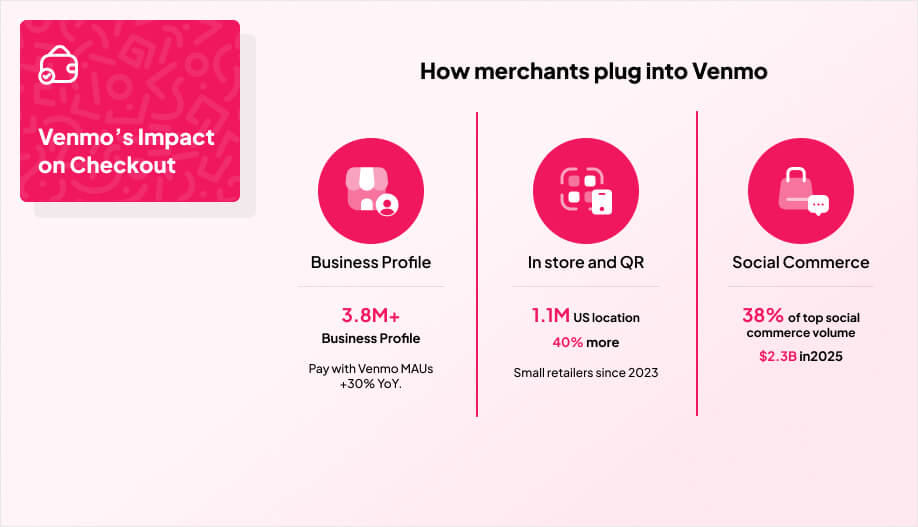
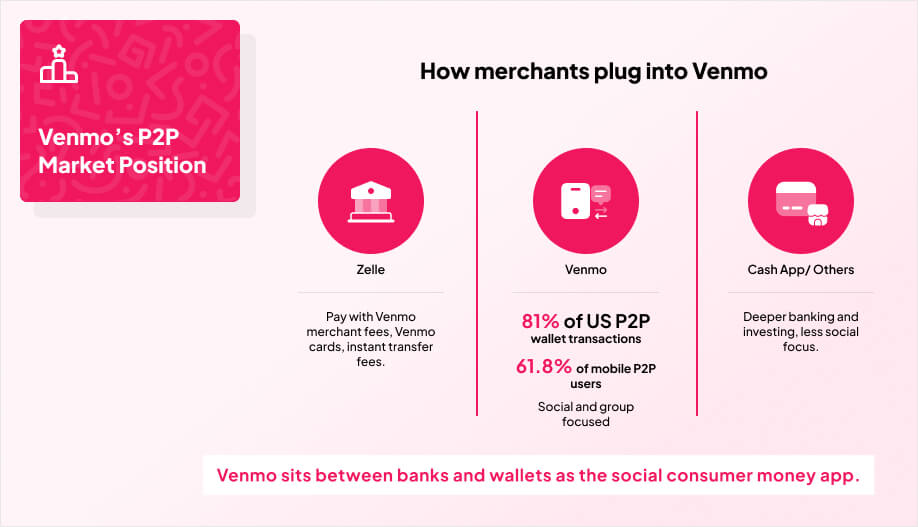
a simple 3-column comparison graphic that shows how merchants plug into Venmo

Once you understand how much money moves through Venmo, the next question is where it touches merchants. That is where the real growth story sits now. 

Venmo still looks like peer to peer on the surface, but underneath you see around 3.8 million Business Profiles and a 30% year over year jump in Pay with Venmo monthly active accounts. In Q2 2025, Venmo’s revenue grew more than over 20% year‑over‑year, reinforcing how quickly these merchant-facing channels are turning into a serious profit engine.

Our experience building commerce apps shows that integrating native payment options drives higher conversion rates, so treat Venmo as a core payment consideration.

On the ground, QR acceptance has reached about 1.1 million US retail locations, and more than 40% of small retailers added Venmo between 2023 and 2025, with in store usage growing faster than online. This expansion aligns with the habits of a digital-native customer base that spends many hours on mobile phones daily and prioritizes seamless social commerce experiences. AppMakers USA is focused on scalable, high-traffic solutions means merchants can rely on fast load times when integrating Venmo.

Social commerce is where this momentum really shows up. Venmo has handled an estimated 38% of social commerce transactions across the top 100 platforms and moved about 2.3 billion dollars in 2025, driven largely by Gen Z and Millennial users. Backed by an active base of roughly 62 million users in 2025, it gives merchants instant access to scaled demand with almost no extra onboarding friction. 

If you are planning a new commerce build, our view at AppMakers USA is simple: treat Venmo as a core UX and payment decision, not a late stage add on.

How Venmo Turns “free” Payments Into a Real Business

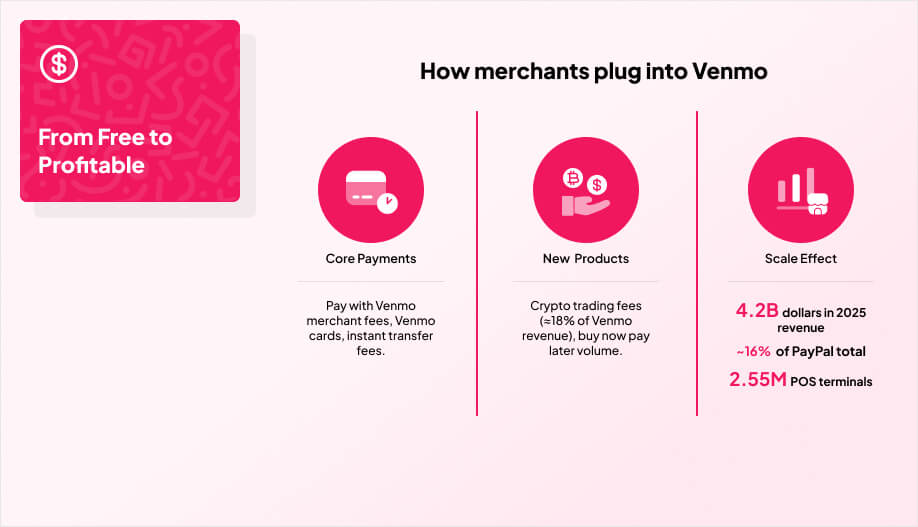
a simple 3 column comparison graphic that shows how Venmo makes money on top of P2P

Venmo’s monetization engine looks a lot more like a diversified fintech platform. 

The user feed and simple payback flows keep people engaged. The business model lives in the background, where millions of small transactions and merchant checkouts turn into real fees. This growth is mirrored in Venmo’s reported Total Payment Volume statistics, which track the billions of dollars processed on the platform each quarter.

Most of the engine is still classic payments. Pay with Venmo merchant fees, interchange from the Venmo debit and credit cards, and instant transfer fees make up the bulk of revenue. In 2025, Venmo brought in roughly 4.3 billion dollars and about 16% of PayPal’s total revenue according to PayPal’s reporting, which tells you how much cash you can pull from a “no subscription” consumer app once the volume is there. 

Merchant service fees and in store acceptance at roughly 2.55 million terminals are a big part of that, since they monetize the same users who started with simple peer to peer transfers.

On top of that base layer, Venmo has added higher margin products. Crypto trading fees now account for an estimated 18% of Venmo revenue as users buy, sell, and hold Bitcoin and other assets inside the app. Buy now, pay later volume, including PayPal Pay Later, pushes quarterly payments revenue higher and shows how critical pay later options have become to PayPal’s growth strategy overall. None of these products feel bolted on to end users. They show up as optional tools inside an app that already handles their day to day money movement.

The takeaway is to not start by stuffing a product with monetization tricks. You start by building a payment experience that becomes a habit. Then you find the points in that flow where merchants, power users, or higher risk actions can reasonably carry fees. 

If you are designing your own fintech product, Venmo’s mix of merchant fees, card usage, instant transfers, and optional add ons is a useful blueprint for how to turn high engagement into a diversified revenue stack without breaking trust.

Where Venmo Really Stands in the P2P Payment Race

a 3 column competitor comparison graphic that shows how Venmo stacks up in P2P payments

Venmo’s monetization engine only makes sense when you see how far it has pulled ahead in peer‑to‑peer payments. Estimates put it at 81% of US P2P digital wallet transactions and about 61.8% of mobile P2P users in 2025, with the user base projected to reach 107.6 million

As P2P ecosystems expand into digital gift cards and stored value, Venmo is well positioned to sit at the center of budgeting and light savings flows, not just quick paybacks. It outperforms Zelle in engagement, leads Cash App in P2P share, and sits between PayPal and Apple Pay in the broader digital payments stack. 

For larger, trusted transfers, many users still rely on Zelle for its bank-level security and absence of a public transaction feed, even if it lacks Venmo’s social features.

From our vantage point at AppMakers USA, Venmo is a useful blueprint for sticky product design and this means social feeds that feel light, emoji and notes that make transactions feel human, and group flows that make splitting costs almost automatic. 

Underneath, it uses data analytics to refine engagement and personalize offers in the same way other leading platforms do. Those choices help it capture younger, tech savvy users and then extend from pure P2P into e-commerce and business payments. If you are building in this space, you should benchmark your flows against it and be honest about where you want to be different.
Dejan Kvrgic

Dejan Kvrgic

Dejan Kvrgić is the Senior Marketing Manager at AppMakers USA. He oversees marketing strategy, user acquisition planning, and growth operations across a wide range of app development projects.

Ready to Develop Your App?

Partner with App Makers LA and turn your vision into reality.
Contact us

Frequently Asked Questions (FAQ)

Yes, but you will not beat Venmo at being Venmo. Its tens of millions of users and large share of US P2P volume mean you should target a clearer niche, workflow, or industry instead of generic “pay anyone” use cases. At AppMakers USA we usually advise founders to anchor around one tight problem, then layer payments into that, not the other way around.

Copy the discipline: simple flows, high frequency use cases, and fees tied to clear extra value like speed or merchant tools. Do not copy every product experiment or assume you can bolt on crypto and BNPL just because Venmo did; those moves sit on top of a huge scale and a mature risk engine. We help teams decide which Venmo style ideas actually fit their user base instead of chasing the full menu.

Venmo encrypts data and logs your transactions, device details, and in app activity. It can share information with PayPal, partner banks, and law enforcement when required, and a lot of payment history is social by default unless you lock it down in settings. From an AppMakers USA perspective, we treat this as a caution flag: build products that are private by default, make data use easy to understand in plain language, and give people simple, front and center controls instead of burying the important switches.

Like crafting your own Troy, you’d need clear requirements, secure payment architecture, PCI compliance, and polished UX; at AppMakers USA , we’d guide you from concept to launch in 4–6 months with fully custom features.

You move faster if you stand on existing rails, but you also live with their rules, fees, and roadmap. For many early stage products, that tradeoff is fine as long as you design a path to more control later if volume and margins demand it. When we architect fintech products at AppMakers USA, we assume you will start on third party rails and only invest in deeper ownership if the numbers justify it.

See more
Chevron-1

Turning Venmo’s Playbook Into Your Roadmap

Venmo is proof that you do not need a complicated product to build a serious payments business. It won by making money movement simple, turning that into a daily habit, then charging in a few specific places where speed, convenience, or merchant value clearly justify a fee. 

You probably do not need Venmo scale, but you do need that level of clarity. 

If you are planning a payment driven product, the real work is mapping where money already wants to flow, what behavior you can realistically own every week, and which touchpoints can carry fees without feeling predatory. That is the kind of roadmap we build with clients at AppMakers USA. 

If you want help with pressure testing your idea or existing app against a Venmo style model, reach out through the contact page and we can walk through the numbers together.


Exploring Our App Development Services?

Share Your Project Details!

Vector-60
We respond promptly, typically within 30 minutes!
Tick-4
  We’ll hop on a call and hear out your idea, protected by our NDA.
Tick-4
  We’ll provide a free quote + our thoughts on the best approach for you.
Tick-4
  Even if we don’t work together, feel free to consider us a free technical
  resource to bounce your thoughts/questions off of.
Alternatively, contact us via phone +1 310 388 6435 or email [email protected].
    Copyright © 2026 AppMakers. All Rights Reserved
    Follow us on socials:
    linkedin facebook pinterest youtube rss twitter instagram facebook-blank rss-blank linkedin-blank pinterest youtube twitter instagram