How to spot technical debt before it becomes expensive starts understanding that you usually feel it before you can name it. Delivery slows down. “Small” changes turn into week-long projects. Engineers hesitate to touch certain areas because they know something will break.
That’s technical debt showing up as friction, not just messy code.
The goal is not perfection. Some mess is normal. Debt is the stuff that keeps charging interest, it increases cycle time, raises defect risk, or makes core flows harder to change safely. If it’s not doing one of those, it’s probably not your biggest problem.
In this guide, we’ll focus on practical signals you can spot early, the metrics that confirm what you’re seeing, and a simple way to decide what to fix first so costs don’t spike later.
When you’re serious about scaling a product, spotting technical debt is not gut feel. It’s treating your codebase like a system with measurable friction points.
Start by instrumenting the work itself. Track cycle time from first commit to release, defect density, and bug creation versus closure. Next, interrogate structure. Use complexity and cyclomatic complexity to quantify how hard code is to reason about.
This is also where a disciplined review cadence matters.
Below, we’ll break this into two practical layers: the metrics that confirm where debt is building, and the tools that help you find the hotspots fast.
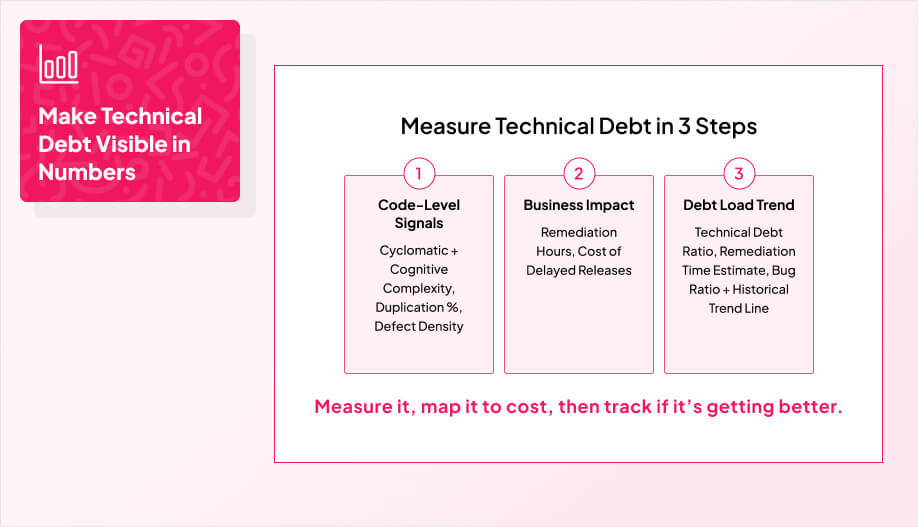
A team doesn’t really understand its technical debt until it can see it in numbers, not just feel it in firefights and slow releases.
1) Start with code-level signals
Track a small set consistently:
2) Tie it to business impact
Translate the engineering pain into something leadership can prioritize:
3) Quantify “debt load” and trend it
Use tools to estimate the shape of the problem and whether it’s improving:
In AppMakers USA audits and delivery work, we typically wire these into CI/CD with simple quality gates and developer feedback loops, then use portfolio views (like CAST Highlight, vFunction, or CodeScene) to watch debt across systems over time, not just per file.
CodeScene’s CodeHealth view is useful here because it highlights long-lived hotspots and how change patterns keep making them worse.

You’ll usually see technical debt first in your delivery friction and your trend lines, long before systems start “breaking.” Stripe’s Developer Coefficient estimated developers spend 42% of their time on maintenance work tied to bad code and related issues, which matches what teams feel when debt starts constraining change.
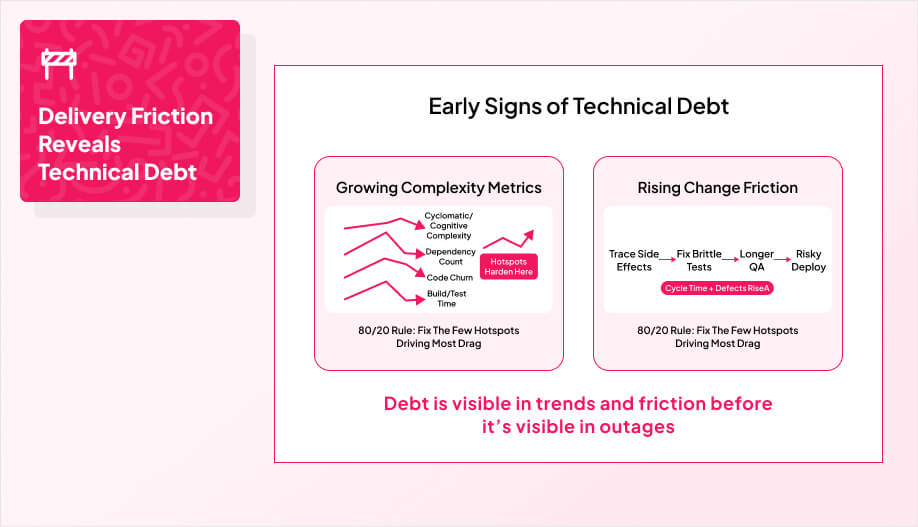
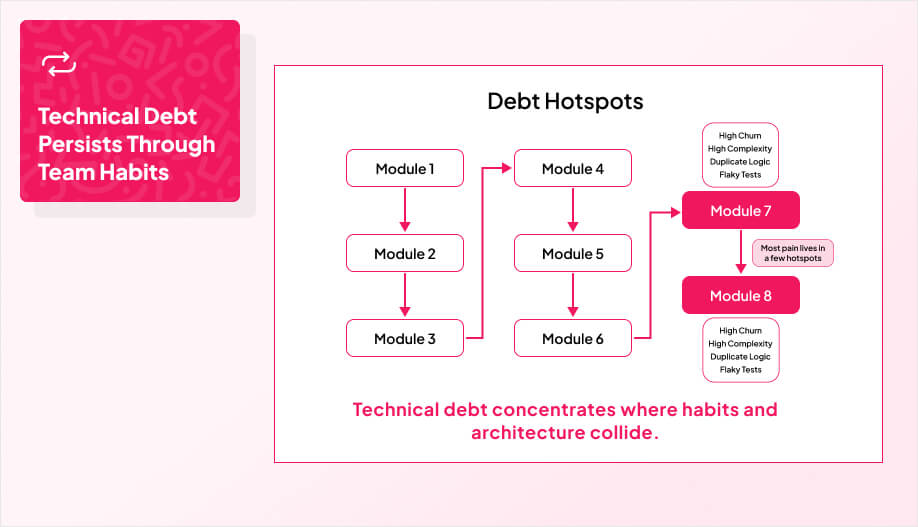
When complexity indicators climb while “simple” work gets slower and riskier, you’re watching the interest kick in. This is also where the 80/20 rule matters. A small set of hotspots tends to cause most of the drag, so you fix those first and stop burning cycles everywhere else.
Even before outages or missed deadlines, debt shows up as rising complexity. Cyclomatic and cognitive complexity creep up, code paths multiply, and “safe changes” get rarer. Watch for code churn and volatile files too. If the same areas are constantly touched by multiple people and still feel unstable, that’s a hotspot hardening.
As teams adopt architectures powered by 5G and edge computing, unnoticed complexity in distributed workflows can quickly magnify operational risk. Large files, growing dependency counts, deep inheritance, and high coupling usually mean the design is calcifying into something brittle. Rising build and test latency is another early tell. It slows feedback, stretches cycle time, and makes teams avoid small refactors that would have prevented bigger problems.
Track a simple Technical Debt Ratio over time so this stays visible in planning, not just in retros. When you tie these signals into an Agile development cadence, remediation becomes part of delivery, not an emergency side quest.
Technical debt stops being theoretical when a one-line tweak takes days. People spend more time tracing side effects, navigating brittle tests, and negotiating code review risk than actually changing behavior. That is a change in friction, and it’s often your clearest signal that alterability is degrading.
Ward Cunningham’s metaphor still holds up in which the “interest” shows up as longer cycle times, growing QA effort, and nervous deployments. Then it gets self-reinforcing.
In a fast-moving Los Angeles tech ecosystem, this kind of drag can quietly erase the advantages of rapid iteration and local market opportunities. Small refactors get postponed, the next change gets harder, and you lose options. Experiments, revenue features, and even compliance updates start costing more than they should.
When that drag becomes normal, it’s time to pay down debt deliberately, starting with the few hotspots driving most of the pain.

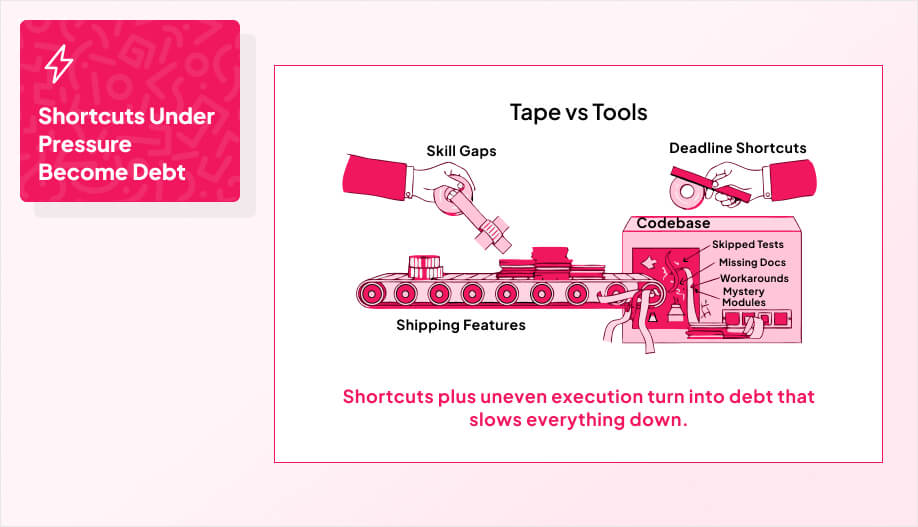
Once you start measuring debt, the root causes usually collapse into the same loop: deadline pressure creates shortcuts, and skill gaps turn those shortcuts into permanent patterns.
When deadlines dominate every conversation, teams quietly trade testing, refactoring, and documentation for “just ship it.” Ambiguous goals and shifting requirements make it worse. You guess, patch, and promise to clean it up later. Those “temporary” workarounds harden into architecture, slowing every new feature and raising risk with each release. This is also where security gaps sneak in, because rushed code tends to skip the boring safeguards.
At the same time, hidden skill gaps keep the system fragile. This is not only junior devs. It’s also outsourced code nobody fully owns, weak onboarding, missing docs, and “mystery modules” teams avoid. Under pressure, people reach for what they know, not what the architecture needs, so patches replace design. Over time, skipping regular updates and refactoring in favor of new features becomes neglected maintenance that compounds debt and makes changes feel dangerous.
The fix is not “slow down.” It’s making tradeoffs explicit and repeatable:
This is the kind of work AppMakers USA typically supports through hands-on code reviews and an agile approach that keeps testing, refactoring, and documentation in scope when timelines get tight.

Deadline pressure and skill gaps explain why debt starts. This section is about why it stays.
Technical debt rarely shows up as one dramatic mistake. It shows up as repeatable behaviors in how teams write, structure, and maintain the system. In native app development, these patterns quietly chip away at performance, UX, and long-term scalability if you let them run unchecked.
The table shows the repeatable behaviors in your code and release flow that matter most and what to do first.
| Signal you’ll notice | What it usually means | What to do first |
|---|---|---|
| Complexity keeps climbing (cyclomatic/cognitive) | Logic is getting harder to reason about, so reviews slow and changes feel risky | Split the hotspot, simplify branching, add tests around the critical path |
| The same files keep getting touched (high churn hotspots) | Weak boundaries; too much depends on a few “god” modules | Introduce clearer module/service boundaries, isolate dependencies behind interfaces |
| Copy-paste logic spreads | No single source of truth, so bugs repeat in multiple places | Extract shared logic, standardize patterns, remove duplicate implementations |
| Tests stop protecting releases (flaky tests, low coverage in core flows) | Teams can’t change code confidently, so fixes create regressions | Stabilize flaky tests first, then add coverage only on the most-used flows |
| Cycle time stretches and releases get heavier | Debt is now affecting delivery, not just code quality | Track lead time + change failure rate, then prioritize fixes in top 1–2 hotspots |
When we work with teams on AppMakers USA builds, we treat these as system signals. The fix is usually a mix of tightening boundaries, strengthening test protection around the critical paths, and adjusting workflows so teams stop re-breaking the same hotspots.

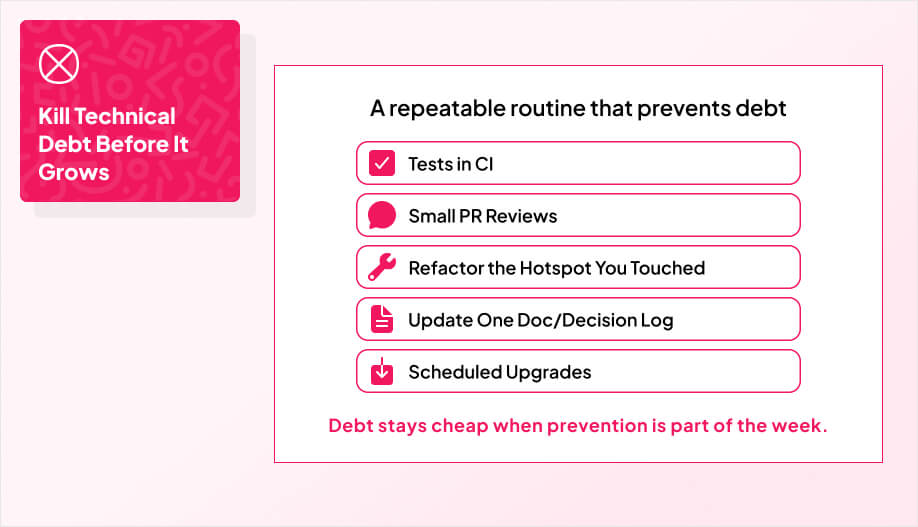
The causes are usually the same. The prevention is, too. When you treat technical debt as a daily operating habit, not a once-a-year cleanup project, it stays small and boring.
Start with automated tests (unit, integration, end-to-end) and run them continuously in CI so regressions show up while the change is still fresh. This is not theory. NIST estimated inadequate software testing infrastructure costs $59.5B annually, and feasible improvements could reduce costs by $22.2B, largely by catching issues earlier and more reliably.
Then keep the system readable and safe to change:
When AppMakers USA sets up delivery workflows for clients, we usually bake in CI quality gates, review rules, and a steady upgrade rhythm so debt does not get a chance to pile up.

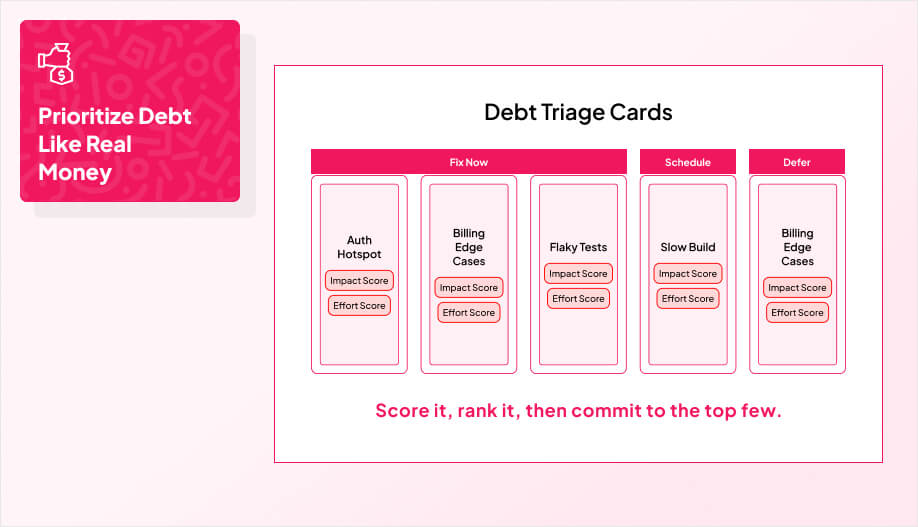
Daily habits keep new debt from piling up. The hard part is the backlog that already exists, where everything feels urgent and nothing is clearly worth the cost.
McKinsey reported that 30% of CIOs surveyed believe more than 20% of the technical budget meant for new products gets diverted to resolving tech debt issues. That’s why you need a defensible triage process, not vibes.
Use this sequence:
Then sanity-check the top picks against business goals, NPS pain, and near-term roadmap commitments. When AppMakers USA runs debt triage with teams, the output is a short list leadership can defend, plus a clear “not now” list that stops the backlog from turning into a junk drawer again.
Tie it to outcomes they already track: slower release cadence, higher incident risk, missed roadmap dates, and rising support load. Keep it concrete: “This area adds 3 days to every change” lands better than “the architecture is messy.”

Where it lives, what it breaks or slows, how you’ll know it’s fixed (a measurable outcome), and what happens if it’s deferred. Add a rough blast radius note (which teams/services it touches) so it doesn’t get deprioritized by accident.
When reliability or delivery predictability is slipping and you’re paying the same “tax” every sprint. If releases feel scary, hotfixes are routine, or teams avoid certain modules, that’s the moment to trade a small feature slowdown for a bigger speed-up later.
Assign real ownership, put the hotspot behind tests, and document the “why” for key decisions (short decision logs beat long docs). If you can’t safely change it, you don’t own it.
Stabilize the top hotspot with test protection and a small boundary cleanup. One solid seam (interface/module split) plus a few critical-path tests often unlocks faster changes immediately. If you want an outside review, AppMakers USA can run a targeted audit and give you a short, prioritized fix list your team can actually execute.
Technical debt gets expensive when it stops being an engineering problem and starts dictating what the product team can safely ship. The good news is you can usually see it coming. The signals show up in friction, hotspots, and trend lines long before a system falls over.
The move is to measure a few indicators consistently, keep debt visible as a portfolio, and fix the small set of hotspots that are taxing every change. Do that, and you protect speed without betting the roadmap on heroics.
If you want a second set of eyes, AppMakers USA can run a focused debt audit and turn the findings into a short, defensible fix plan your team can execute without stalling delivery.